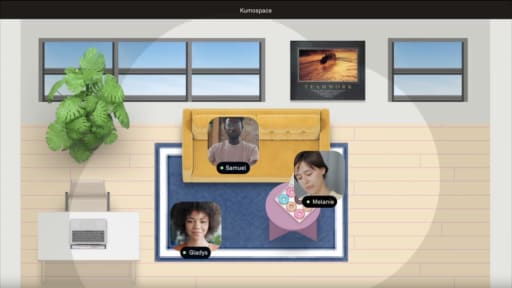
Communal work spaces refer to any work environment where multiple companies, freelancers, or distributed team members share physical or virtual infrastructure. The concept has evolved significantly since the early coworking pioneers of the mid-2000s, and today the category spans everything from hot desks in a downtown hub to persistent virtual office floors where globally distributed engineers collaborate in real time.
The post-2020 shift to remote and hybrid work accelerated this evolution dramatically. AI startups founded between 2020 and 2026 grew up with distributed teams as the default, and they needed workspace solutions that could adapt to headcount swings, geographic spread, and the capital constraints of early-stage companies.
Here’s how the main formats break down:
- Physical coworking spaces: Shared facilities with hot desks, dedicated desks, private offices, and meeting rooms available on flexible terms, typically month-to-month rather than multi-year leases
- Shared office space: A private office or suite within a larger communal building, giving teams their own space while accessing shared amenities like kitchens, lounges, and event areas
- Hot desks: Open seating that members can book by the day or month, ideal for individual engineers or small teams that don’t need permanent desks
- Virtual communal spaces: Platforms like Kumospace that create persistent spatial environments where distributed teams can “sit together” online, move between virtual rooms, and collaborate as if sharing a physical office
- Hybrid setups: Combinations of the above, such as a team with a small private office in a coworking hub plus a Kumospace floor for daily virtual standups with remote members
The key difference from traditional corporate leases is flexibility. Communal work spaces let you grow from three desks to thirty without renegotiating a 10-year contract. They also eliminate the upfront costs of fit-outs, furniture, and IT infrastructure, resources that AI startups would rather spend on computers and talent.
Not all communal work spaces serve the same purpose. A founding team of three ML researchers has different needs than a 50-person engineering organization with specialists across backend, data, and applied AI. The workspace types below can be mixed and matched as your company scales from pre-seed through Series B and beyond.
Each type works best for specific team configurations and work patterns:
- Private offices for teams needing quiet and security for model design and sensitive data discussions
- Coworking access and hot desks for individuals and small groups who value flexibility and networking
- Meeting rooms and project rooms for focused collaboration sessions, interviews, and investor presentations
- Virtual spaces like Kumospace for distributed teams that want the benefits of shared presence without physical co-location
Private Offices within Communal Work Spaces
A private office inside a coworking space gives your team a dedicated room, typically furnished with desks, chairs, and whiteboards, while retaining access to shared amenities like kitchens, lounges, and bookable meeting rooms. For AI teams, this setup balances the need for focused technical work with the community benefits of a larger shared environment.
Why private offices matter for ML and AI work:
- Noise control for deep work: Code reviews, architecture discussions, and model debugging require concentration. A lockable room eliminates interruptions common in open layouts.
- Security for sensitive conversations: Teams working with proprietary model weights, PII, or unreleased product features can discuss freely without worrying about eavesdroppers.
- Whiteboard-heavy collaboration: Applied ML work often involves sketching data pipelines, loss functions, and system diagrams. Private spaces with large whiteboards support this better than cramped café tables.
- Interview hosting: A private office provides a professional, distraction-free setting for back-to-back technical screens.
Example scenario: A Series A AI startup with a 12-person applied ML squad leases a private office in a communal hub in New York. They use the space for daily standups, pair programming sessions, and architecture reviews. When they need extra capacity for onsite interviews, they book adjacent meeting rooms in the same building without separate contracts.
Typical amenities in private office setups include lockable doors, dedicated high-speed internet, access to phone booths for calls, and in some AI-focused hubs, network infrastructure optimized for large model downloads and GPU-heavy workloads.
Coworking Access and Hot Desks

Coworking access refers to shared open-plan desks that engineers and data scientists can book by the day or month. Hot desks are the most flexible variant; you show up, pick an available seat, and get to work. This model works well for individuals, small teams without permanent space needs, and companies offering workspace stipends to remote employees.
For individual engineers, including freelance ML engineers between contracts or candidates exploring opportunities, hot desks provide a professional base of operations without the overhead of a dedicated office.
Key characteristics of coworking and hot desk setups:
- Flexibility: Book a desk for a single day or commit to a monthly pass. Scale up or down as your team size fluctuates.
- Cost efficiency: Hot desks typically run $200–500 per month depending on the city, far less than the per-person cost of a traditional lease.
- Networking upside: Shared kitchens, lounges, and community events expose you to other founders, ML researchers, and potential collaborators. Industry reports suggest 90 percent of coworking members cite community as a key benefit.
- Geographic distribution: Remote-first AI companies can give employees coworking stipends to work from local hubs two to three days per week, creating consistency without forcing everyone into a single headquarters.
Practical example: A remote-first AI company with engineers in San Francisco, Austin, and Berlin provides each team member a $400 per month coworking stipend. Engineers choose local hubs that suit their schedules, meeting up in person for quarterly offsites while staying connected daily through their virtual Kumospace office.
Shared Meeting Rooms and Project Rooms
On-demand meeting rooms inside communal work spaces serve purposes that open desks cannot: sprint planning, technical design reviews, investor pitches, and candidate interviews. For AI teams, these rooms are often the site of the most consequential discussions.
What makes communal meeting rooms valuable for engineering teams:
- Bookable by the hour or day: Pay only for the time you need instead of maintaining underused conference rooms year-round.
- Professional AV setups: Screens for live coding interviews, virtual whiteboards, and reliable video conferencing integrations with tools like Zoom and Kumospace for hybrid sessions.
- Privacy for sensitive topics: Enclosed rooms with soundproofing let you discuss compensation, performance, or product strategy without the entire coworking floor overhearing.
- Interview logistics: You can book a suite of rooms for a focused 1–2 day interview sprint, handling back-to-back technical screens, system design sessions, and culture conversations in one location.
Virtual Communal Work Spaces (e.g., Kumospace)
Virtual communal spaces represent a newer category that became mainstream after 2020. Platforms like Kumospace create spatial video environments where distributed engineering teams can sit together online, moving between rooms, dropping into conversations, and maintaining the ambient awareness that physical offices provide.
For AI startups with globally distributed staff, a Kumospace floor can serve as a persistent virtual office that complements or replaces physical coworking. Team members log in each morning to their virtual desk, see who else is online, and initiate conversations as naturally as walking over to a colleague’s workspace.
How AI teams use virtual communal spaces:
- Daily standups in a virtual “war room”: The entire engineering team gathers in a designated room for a 15-minute sync, then disperses to their work.
- Pair-programming corners: Engineers working on a shared problem sit together in a virtual room with screen sharing and spatial audio.
- Product review lounges: Cross-functional groups gather to demo features, review model outputs, and plan next iterations.
- Remote interviews: Hiring teams can run Match Day interview loops inside Kumospace, with labeled rooms for each stage: intro, technical screen, system design, team fit. Candidates experience a cohesive process even when interviewers are in different cities.
Virtual spaces also support onboarding. New hires can take a virtual orientation tour, meet teammates at their desks, and get a feel for the company culture before their first day.
The key advantage is instant access from anywhere. A 25-person team across four time zones can maintain daily face time without anyone booking flights. Companies that adopt virtual communal spaces report significantly higher engagement among distributed team members compared to those relying on scheduled video calls alone.

AI startups operate under a specific set of constraints: volatile funding environments, rapid headcount changes, pressure to ship models quickly, and a talent market where elite engineers have options. Communal work spaces, both physical and virtual, address these constraints in ways traditional offices cannot.
The growth of AI-focused coworking clusters in hubs like San Francisco, London, and Bangalore reflects this fit. Startups that chose communal work spaces and tools like Kumospace could iterate quickly on products and hiring while preserving capital for what matters most: compute, data, and people.
The benefits break down into four main categories.
Speed and Flexibility for Rapidly Scaling Engineering Orgs
AI companies often experience non-linear growth. A team might stay at five engineers for 18 months, then triple in size after raising a Series A. Traditional leases punish this pattern since you’re either paying for empty desks or scrambling to find new space when you need it.
Communal work spaces solve this with flexible agreements:
- Month-to-month or short-term contracts: Expand from three hot desks to a private office to multiple suites without renegotiating a five-year lease.
- Instant physical scaling: A company raising a Series B in 2024 can add two extra rooms and more desk passes in the same hub within weeks, not months.
- Virtual scalability: Kumospace floors can absorb new hires globally without any physical buildout. An engineer joining from São Paulo gets instant access to the same workspace as colleagues in San Francisco.
Example: A founding team closes a Seed round in January 2026 with three members. By April, they have added two ML engineers and need more space. They upgrade from hot desks to a six-person private office in the same coworking hub with the same address, same community, no relocation friction.
This flexibility lets you adapt your workspace to match hiring velocity rather than the other way around.
Cost Optimization vs. Traditional Office Leases
Every dollar an AI startup spends on real estate is a dollar not spent on GPUs, data labeling, or the elite engineers who build the models. Communal work spaces shift this balance.
Consider the numbers for a 10-person AI team in 2026:
|
Expense Category |
Traditional Lease (Annual) |
Communal Work Space (Annual) |
|
Base rent |
$150,000+ |
$60,000–80,000 |
|
Fit-out and furniture |
$30,000–50,000 upfront |
Included |
|
IT infrastructure |
$15,000+ |
Included |
|
Utilities and maintenance |
$10,000+ |
Included |
|
Flexibility to downsize |
Difficult |
Month-to-month |
The savings are substantial, but the real win is capital reallocation. Founders can redirect $50,000–100,000 per year toward:
- ML infrastructure, such as GPUs on AWS, GCP, or on-prem
- Data labeling and annotation
- Hiring elite engineers
- Product development velocity
Virtual communal spaces like Kumospace further reduce costs by minimizing travel expenses for distributed teams. A team that would have flown engineers in quarterly for in-person collaboration can now maintain daily face time without the flights.
Community, Serendipity, and Cross-Pollination
AI work does not happen in isolation. The best ideas often emerge from unexpected conversations like a chat with a designer at the coffee machine, a whiteboard session with a founder facing similar challenges, or an introduction to an investor at a coworking event.
Communal work spaces create these opportunities by design:
- Shared kitchens and lounges: Natural gathering points where engineers from different companies cross paths
- Community events: Demo days, paper reading groups, and founder meetups curated by the coworking space
- Specialized communities: Some hubs focus specifically on AI and deep tech, attracting a thriving community of ML researchers, founders, and engineers
Real-world pattern: An applied ML engineer working from a coworking space in 2026 meets a product designer from another startup at a community lunch. Six months later, they are co-founding a company together, a connection that would not have happened in a home office.
Virtual communities offer similar serendipity. Shared Kumospace floors for AI builders across companies create informal opportunities for peer code reviews, paper discussions, and career conversations. These network effects accelerate learning and surface opportunities for distributed engineers.
Better Collaboration for Complex Technical Work
AI development involves deeply collaborative work: model architecture design, data pipeline optimization, evaluation framework development, and the constant iteration between research and engineering. This work benefits from spaces that support both focused individual time and intense group collaboration.
What communal work spaces provide for technical collaboration:
- Whiteboards and large screens: Essential for sketching model architectures, data flows, and system designs during design reviews
- Breakout booths and phone rooms: Quiet spaces for pair programming or debugging sessions without disturbing others
- Flexible room configurations: Book a project room for a two-hour architecture session, then return desks to deep work
- Hybrid-friendly infrastructure: AV setups that make it easy to include remote team members via Kumospace or video calls during in-person sessions
Example workflow: A distributed team with engineers in London and Toronto coordinates across time zones. Twice a week, the London contingent gathers in their communal hub for in-person design reviews, with Toronto joining via Kumospace. The physical space provides the whiteboards and discussion energy, and the virtual layer ensures everyone participates equally.
This hybrid model improves decision-making quality. Complex technical choices benefit from synchronous discussion without requiring everyone to relocate.

Choosing the right mix of private offices, coworking access, and virtual spaces requires intentional planning. The goal is a workspace strategy that supports your current team while leaving room to grow, aligned with your hiring roadmap and the engineers you plan to bring on.
A thoughtful approach considers several dimensions:
- Work patterns: How much synchronous collaboration does your team need versus individual deep work?
- Location strategy: Where are your current and future engineers located, and what hubs make sense?
- Physical-virtual blend: What is the right balance between in-person coworking days and virtual office presence?
- Security requirements: What data and IP considerations affect your workspace choices?
The following subsections provide practical guidance for each.
Mapping Work Patterns and Team Needs
Start by understanding how your team actually works. Different roles and project phases have different workspace requirements.
Questions to answer:
- How often do engineers need synchronous collaboration versus heads-down coding time?
- Which activities benefit most from in-person presence (whiteboarding, interviews, team building)?
- How do roles vary? Applied ML engineers might pair frequently, while infrastructure engineers may work more independently.
Based on these answers, create a weekly rhythm that matches your sprint cycles:
|
Day |
Location |
Primary Activities |
|
Monday |
Virtual (Kumospace) |
Async work, 1:1s, individual deep focus |
|
Tuesday |
Communal hub |
Sprint planning, design reviews, team lunch |
|
Wednesday |
Virtual (Kumospace) |
Pair programming, standups, async collaboration |
|
Thursday |
Communal hub |
Interview days, cross-team meetings, presentations |
|
Friday |
Flexible |
Documentation, wrap-up, learning time |
This pattern gives team members predictability so they know when to expect collaboration and when to focus.
Choosing Locations and Providers
Not all coworking spaces serve AI teams equally. When evaluating providers, prioritize hubs near talent pools where you will be hiring:
- Primary AI talent hubs: San Francisco Bay Area, Seattle, New York, Toronto, London, Berlin, Bangalore
- Emerging clusters: Austin, Miami, Amsterdam, Singapore
Evaluation criteria specific to engineering teams:
- Network reliability: Can you download large models and datasets without throttling? Is there dedicated bandwidth for heavy compute tasks?
- Soundproof rooms: Critical for interviews, sensitive discussions, and focus work
- Security standards: Visitor policies, access controls, and secure Wi-Fi matter when handling proprietary data
- Community fit: Some spaces cater to creative agencies or general freelancers; others focus on tech and AI, offering relevant events and a global network of like-minded professionals
Comparison example: Coworking Space A offers cheaper hot desks but unreliable Wi-Fi and no private rooms. Space B costs 20 percent more but provides dedicated internet drops, bookable meeting rooms with video conferencing, and a community of AI founders. For an ML team running interviews and handling large datasets, Space B is the better investment.
For teams with members outside major hubs, pair physical locations with a virtual office in Kumospace so everyone feels equally included regardless of city.
Blending Physical Communal Spaces with Kumospace
The most effective workspace strategies combine physical and virtual communal spaces. Here’s a practical playbook for making this work:
Weekly structure:
- 1–2 days per week in a physical communal hub for high-bandwidth collaboration
- Daily presence in Kumospace for standups, async pairing, and ambient team awareness
- Hybrid meetings where some participants are in-person and others join virtually
Cultural practices to establish:
- Always-on virtual desks: Team members keep their Kumospace presence visible during work hours so colleagues know who is available
- Status norms: Clear expectations about when you are in focus mode versus available to talk
- Regular social events: Virtual game nights, demo days, and informal hangouts that build cohesion across locations
Example implementation: A 25-person AI team across four time zones (San Francisco, New York, London, Bangalore) uses this approach:
- San Francisco and New York engineers share a coworking hub, meeting in person Tuesdays and Thursdays
- London and Bangalore engineers work from local coworking stipends
- Everyone logs into Kumospace daily for morning standups, pair programming, and ad-hoc collaboration
- Sprint planning happens in Kumospace with everyone present, and retrospectives happen in-person quarterly during offsites
This blend preserves the benefits of physical presence while enabling the company to hire the best engineers regardless of location, providing flexibility for globally distributed teams.
Security, Compliance, and Data Privacy Considerations
AI teams often work with sensitive data, including training datasets with PII, proprietary model weights, unreleased product features, and confidential business information. Workspace choices should reflect these realities.
Physical space checklist:
- [ ] Private rooms with locks for sensitive discussions
- [ ] Secure Wi-Fi with WPA3 or equivalent (VPN required for additional protection)
- [ ] Clear visitor policies
- [ ] NDA or confidentiality expectations for whiteboards and shared screens
- [ ] Access control (key cards, biometrics) for after-hours entry
Virtual space checklist (e.g., Kumospace):
- [ ] End-to-end encryption for conversations
- [ ] Access controls limiting room entry to authorized team members
- [ ] Integration security with tools used for code and data sharing
- [ ] Compliance certifications relevant to your industry
These considerations reflect the emphasis on rigor and trust that should extend to all workspace operations.
Running Hybrid and Remote Interviews from Shared Spaces and Kumospace

Not every interview requires everyone in the same room. Hybrid and remote interview setups let you evaluate candidates across time zones while maintaining a consistent, professional experience.
Hybrid setup: Interviewers sit in a communal workspace while candidates join remotely, or vice versa.
- Use meeting rooms with reliable AV equipment and good lighting.
- Ensure the remote participant sees a professional background, not a chaotic coworking floor.
- Use tools like Zoom or Kumospace for the video connection.
Fully virtual in Kumospace: Create a virtual interview “floor” with labeled rooms for each stage of the loop.
- Waiting room: Candidate joins here, greeted by a coordinator or hiring manager
- Technical screen room: Screen sharing for live coding, spatial audio for natural conversation
- System design room: Virtual whiteboard integration for architecture discussions
- Team fit room: Casual conversation space where the candidate meets potential colleagues
This structure provides a cohesive candidate experience even when interviewers are distributed across multiple cities.
Onboarding New Hires into Your Communal Workspace Culture
The interview is just the beginning. How you welcome new engineers into your workspace shapes their early experience and long-term employee retention.
First-day checklist for communal work spaces:
- [ ] Physical access: Desk assignment or hot desk booking, access badge or key card, tour of the floor.
- [ ] Virtual access: Kumospace login, orientation tour of virtual rooms, introduction to workspace norms.
- [ ] Meet the neighbors: Introduction to community managers and any co-located companies or engineers worth knowing.
- [ ] Equipment setup: Laptop, monitor, peripherals either at their desk or shipped to their home with clear setup instructions.
Early integration practices:
- Schedule pairing sessions in the first two weeks so new hires work alongside experienced team members
- Assign a workspace buddy who can answer questions about both the coworking hub and Kumospace norms
- Include new hires in community events such as coworking happy hours, Kumospace game nights, and demo days
- Hybrid expectations: Make it clear from day one which days are in-person versus virtual, where to find teammates on any given day, and how to signal availability in Kumospace
Hybrid expectations: Make it clear from day one which days are in-person versus virtual, where to find teammates on any given day, and how to signal availability in Kumospace.
When new engineers feel embedded in both the physical and virtual workspace quickly, they ramp faster and contribute sooner. This creates a retention advantage that compounds over time.