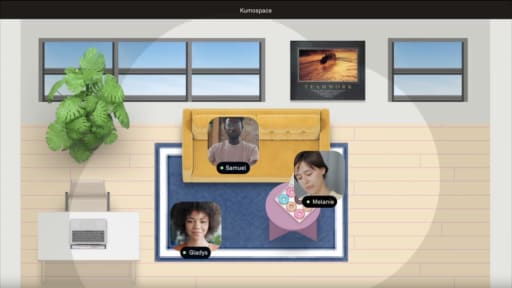
After 2020, work shifted rapidly, with remote and hybrid arrangements becoming standard for millions. Collaboration tools became central, making teamwork the main driver of productivity, innovation, and retention.
Research shows highly collaborative organizations see lower absenteeism, higher productivity, and employees who stay on tasks longer with greater satisfaction and less fatigue. Teams that share ideas, solve problems together, and coordinate in real time achieve better results and retention.
Virtual office platforms like Kumospace help distributed teams recreate spontaneous interactions with persistent digital spaces for real-time collaboration. This article explains what effective collaboration looks like, why it matters, and how to build a culture that delivers measurable results.
What Is Workplace Collaboration?

Workplace collaboration is the process of people from one or more teams working interdependently toward a shared outcome, continuously exchanging ideas, knowledge, and feedback. It goes beyond dividing tasks; true collaboration involves co-creating solutions, jointly owning problems, and combining diverse perspectives to achieve results no individual could accomplish alone.
The distinction between collaboration and teamwork matters. Teamwork involves executing a clear plan with well-defined roles and processes, such as a customer support shift team handling tickets according to established protocols. Success comes from reliable execution within known parameters.
Collaboration thrives in ambiguity. It focuses on discovery, problem-solving, and creating something new, such as a cross-functional product launch where marketing, engineering, customer success, and operations figure out together how to bring a new offering to market. The path forward emerges from collective intelligence, with diverse expertise challenging assumptions and iterating toward the best approach.
High-performing organizations design intentionally for both modes, emphasizing collaboration for discovery, strategic planning, and complex problem-solving, and teamwork for execution and delivery. Treating all work as teamwork can stifle flexibility and creativity. Understanding this distinction is the first step to building systems that support effective collaboration.
What Good Collaborative Working Looks Like Day to Day
Good collaborative working shows up in daily behaviors that compound over time. People proactively share context, provide quick project updates, flag potential blockers, and offer help when colleagues struggle. Fast feedback loops replace long approval chains, with work in progress receiving constructive input within hours rather than weeks.
Collaborative teams co-own problems instead of escalating blame. When issues arise, the focus is on gathering the right people to solve them together rather than pointing fingers or waiting for a manager. This requires psychological safety, where teammates feel comfortable raising risks, asking questions, and respectfully challenging senior colleagues. Without this foundation, collaboration becomes performative rather than productive.
In hybrid settings, collaboration includes clear agendas, short decision-focused meetings, and asynchronous updates that keep everyone informed. For example, a distributed marketing team across New York, London, and Singapore might use daily written updates in a shared channel and one weekly live session to resolve blockers and align priorities, respecting time zones while maintaining connection.
Virtual office tools like Kumospace replicate “hallway moments” online, enabling quick check-ins and informal conversations that support relationship building and creative problem solving without scheduling formal meetings.
Why Collaboration in the Workplace Matters
The strategic value of workplace collaboration goes far beyond feel-good culture statements. When multiple disciplines contribute early, organizations solve problems faster, make better decisions, and shorten time-to-market. For example, software teams including product managers, engineers, designers, and customer success from the start catch issues early, avoiding costly rework.
Cross-functional collaboration has a measurable impact. Companies report reductions in product release cycles, and B2B sales teams working closely with marketing and customer success achieve higher win rates by tailoring proposals with input from colleagues who understand the full customer journey.
Collaboration also strengthens culture. Teams with healthy collaborative norms build trust, increasing future collaboration, boosting employee engagement, and lowering voluntary turnover. One study found workers who collaborate effectively are 64 percent more likely to report high job satisfaction than those working in isolation.
Collaboration improves customer experience. When support, product, and customer experience teams work together on client issues, resolutions are faster and more comprehensive, creating an external perception of coherence that becomes a competitive advantage.
Core Benefits of Effective Workplace Collaboration

The benefits of effective collaboration are measurable within six to eighteen months of implementing improved practices. Leaders investing in collaboration infrastructure can expect gains in efficiency, innovation, team strength, and employee satisfaction, and understanding these mechanisms helps design systems that deliver real results.
Improved Efficiency and Speed
Well-structured collaboration helps complex projects move faster than isolated work because it prevents siloed decision-making, duplicate effort, and handoff failures. Collaborative teams maintain shared visibility into tasks, enabling smoother workflow and faster problem resolution.
Persistent virtual spaces further improve efficiency. Dedicated floors in platforms like Kumospace allow quick conversations that replace scheduled meetings, keeping context in one place and reducing time spent switching tools. This operational speed compounds across dozens of weekly decisions.
Collaboration also drives innovation and problem-solving. Diverse teams bring distinct perspectives, helping groups identify solutions no individual could achieve alone. Companies that systematically bring together employees from different disciplines consistently outperform homogeneous groups.
Stronger Teams and Employee Development
Collaboration accelerates learning in ways formal training cannot. Working closely with colleagues from different functions allows employees to pick up technical skills, tools, and soft skills through observation and practice.
These opportunities impact careers. Employees collaborating across departments gain visibility with leaders, find mentors, and become more promotable by understanding the organization as a whole. In one professional services firm, cross-functional project participants were twice as likely to receive promotions within two years compared to those in functional silos.
Shared digital spaces can institutionalize informal coaching. Companies using Kumospace have mentoring lounges where junior employees drop in for guidance, making mentorship a natural part of the workday rather than requiring formal scheduling.
Collaboration also boosts engagement, satisfaction, and retention. Employees feel valued, connected, and less isolated, which drives engagement and morale. Recognition of team achievements also helps counter burnout.
Principles of Successful Workplace Collaboration
Beneath specific strategies and tools, successful collaboration rests on a set of principles that act as the operating system for how people work together. These principles apply regardless of industry, company size, or technology stack. They must also be adapted for hybrid and remote realities, where many assumptions from co-located work no longer hold.
Clarity of Goals, Roles, and Decision Rights
Ambiguity is the enemy of collaboration. When people are unclear about what they are trying to achieve, who owns which parts of the work, or who has authority to make decisions, collaboration stalls. Effort is duplicated. Deadlines slip. People disengage because they are uncertain whether their contributions matter.
Practical tactics create clarity. Shared OKRs ensure everyone understands quarterly priorities. RACI matrices make explicit who is responsible, accountable, consulted, and informed for each workstream. Pre-defined decision owners prevent endless meetings where groups discuss but never decide. These structures may seem bureaucratic, but they enable faster, more fluid collaboration by removing friction.
Trust, Psychological Safety, and Empathy
Trust enables the honest feedback, faster conflict resolution, and candid risk-sharing that collaboration requires. When people trust their colleagues, they share work before it is perfect, admit mistakes without fear, and raise concerns early rather than letting problems fester. Without trust, collaboration becomes cautious and superficial.
Simple behaviors build trust over time. Leaders admitting their own mistakes signal that imperfection is acceptable. Rotating meeting facilitation gives different voices authority and visibility. Explicitly inviting dissent in planning sessions such as asking “What are we missing?” or “Who disagrees?” creates space for critical perspectives that improve decisions.
Remote and hybrid contexts require additional attention to trust-building. Reading tone in text messages is difficult, and misunderstandings can escalate quickly. Using video strategically helps people connect as humans, not just task-executors. Virtual coffee spaces in tools like Kumospace provide informal opportunities for the relationship-building that sustains trust through difficult projects.
Accountability and Follow-Through
Collaboration becomes ineffective when no one owns outcomes. If collaborative sessions generate ideas and discussion but no clear action items with owners and deadlines, the time invested produces no value. This is a common failure mode for organizations that confuse activity with progress.
Visible task boards with clear ownership and due dates create accountability without micromanagement. Brief written summaries after collaborative sessions capture decisions and next steps so nothing falls through the cracks. These practices are not about control as they are about ensuring collaborative energy translates into results. Virtual spaces can host recurring rituals that create rhythm and accountability.
Inclusivity and Digital Inclusivity
Inclusivity means ensuring all relevant voices are heard, not just those who speak the loudest or happen to be in the same time zone as leadership. Without intentional design, collaboration naturally favors extroverts, senior employees, and those in headquarters locations. This exclusion wastes talent and produces poorer outcomes.
Practical strategies address these dynamics. Rotating speaking order in meetings ensures everyone contributes. Async input on documents before discussions gives reflective thinkers time to formulate responses. Recording key sessions allows colleagues in other time zones to stay informed and contribute comments asynchronously.
Design choices in collaboration tools matter for accessibility and different work styles. Platforms like Kumospace that offer captioning, clear visual zones, and multiple modes of participation help teams include colleagues with different needs.
Strategies to Build a Collaborative Culture

Culture change requires sustained effort over twelve to twenty-four months, but leaders can begin seeing results from specific interventions within a single quarter. The strategies below provide a roadmap for organizations serious about making collaboration a competitive advantage rather than a buzzword.
Develop a Collaboration-First Culture
Leadership behaviors, hiring practices, and recognition systems collectively signal whether collaboration is truly valued or merely discussed. If executives reward individual heroics while paying lip service to teamwork, employees quickly learn what actually matters. Culture change starts with aligned incentives.
Leaders can share cross-team wins in all-hands meetings, highlighting how different groups contributed to a shared outcome. Recognition programs can reward teams rather than individuals for major achievements. Hiring criteria can include collaboration capabilities alongside technical skills, with interview processes that assess how candidates work with others.
Set Shared, Transparent Goals
Collaborative goal-setting involves multiple departments in defining quarterly priorities rather than handing down objectives from above. When teams participate in shaping goals, they understand the rationale, feel ownership over outcomes, and can identify potential conflicts early.
Shared dashboards and virtual mission control rooms keep everyone oriented on the same metrics. A revenue team using Kumospace created a dedicated space where sales, marketing, and customer success could all see pipeline status, conversion rates, and customer health scores in real time. This transparency reduced finger-pointing when numbers lagged because everyone understood the full picture.
One manufacturing company resolved a persistent conflict between sales and operations through a joint planning session. Sales wanted aggressive delivery timelines to close deals. Operations needed realistic schedules to maintain quality. Bringing both groups together with shared data led to a new tiering system that gave customers options at different price points and timelines. Neither team would have developed this solution independently.
Keep Communication Open and Actionable
Communication hygiene determines whether information flows support or hinder collaboration. Teams need expectations about concise updates, clear asks, and documented decisions. Without these norms, people drown in noise while missing critical signals.
Defining preferred channels for different types of communication reduces friction. Quick questions might belong in chat. Complex discussions might require video or virtual office time. Announcements might go to email. Response time expectations should be explicit: same-day for urgent items, within two business days for routine requests.
Persistent spaces like Kumospace add value by making it easy to see who is around and initiate quick synchronous conversations when needed. Rather than scheduling a meeting for a five-minute question, teammates can check if the relevant colleague is available and have a real-time conversation. One team codified this norm in their charter: “If you can resolve it in under five minutes, use the virtual office. If it requires more than fifteen minutes of discussion, schedule a meeting.”
Normalize Group Problem-Solving
Organizations that foster collaboration treat problems as collective challenges rather than individual failures. Practices like retrospectives, incident reviews, and structured problem-solving workshops bring cross-functional participants together to learn and improve.
A blameless approach focused on systems and processes rather than individuals creates psychological safety for honest analysis. When something goes wrong, the question is, “How did our processes allow this to happen?” rather than “Whose fault was this?”
Balance Collaboration with Focus Time
Collaboration overload is a real risk. Too many meetings, too many messages, and too many requests for input erode the focused time that knowledge work requires. Organizations must protect deep work while maintaining the connections that make collaboration effective.
Practical tactics include no-meeting blocks where people can work uninterrupted, office hours in Kumospace where colleagues can bring questions during specific times rather than interrupting throughout the day, and clear guidelines about when synchronous conversation is required versus when async communication is appropriate.
Tools and Virtual Spaces That Enable Collaboration (Including Kumospace)
Tools should support collaboration, not define it. The best collaboration tools amplify good habits while making poor practices more difficult. Organizations should think in terms of tool categories and how they work together rather than focusing on individual products in isolation.
The typical collaboration stack for a hybrid or remote team includes virtual offices for presence and spontaneous interaction, project management platforms for visibility and accountability, real-time communication tools for urgent matters, and document collaboration for co-authoring and async work. The key is integration, ensuring information flows between tools rather than getting trapped in silos.
Kumospace: A Virtual Office for Hybrid and Remote Teams

Kumospace is a virtual office platform where teams work together in real time in persistent, customizable digital spaces. Unlike traditional video conferencing, which requires scheduling and feels formal, Kumospace creates an environment where colleagues can see who is around, walk over for a quick question, and maintain the ambient awareness that co-located teams take for granted.
Concrete use cases illustrate the value. Teams hold daily standups on their dedicated floor, with participants joining and leaving as their schedules allow rather than requiring everyone to be present for a fixed time block. During product launches, cross-functional war rooms bring together stakeholders who can huddle quickly, review dashboards, and adapt plans based on real-time information. Casual coffee areas provide space for informal conversations that build professional relationships and surface new ideas.
The collaboration benefits are tangible. Faster decisions come from spontaneous conversations that would otherwise require scheduling. Stronger team presence reduces the isolation that remote workers often experience. Reduced meeting fatigue results from the shift toward drop-in interactions rather than calendar-blocking video calls. For organizations serious about collaborative environments, virtual offices address gaps that chat and email cannot fill.
Project and Task Management Platforms
Shared task systems are critical for accountability and visibility across distributed teams. When everyone can see what work is in progress, who owns each item, and what deadlines are approaching, coordination happens naturally without requiring constant check-ins.
A typical workflow involves prioritizing weekly work in a planning session, assigning owners with clear due dates, and tracking progress as items move through stages. The most effective teams integrate project boards with their communication tools so updates flow automatically and conversations stay linked to relevant tasks.
One marketing team connects their project management software directly to their Kumospace presence. When someone is working on a specific campaign, their status shows which project they are focused on. Colleagues who want to discuss that campaign can see at a glance whether the right person is available.
Real-Time and Asynchronous Communication Tools
Effective collaboration requires both synchronous and asynchronous communication, used appropriately. Synchronous tools like video calls and virtual offices excel at complex discussions, relationship-building, and resolving ambiguous issues. Async tools like chat, email, and recorded video updates work better for information sharing, thoughtful responses, and bridging time zones.
The mistake many organizations make is defaulting to synchronous communication for everything, resulting in meeting overload and fractured focus time. A better approach combines scheduled deep-dive sessions with on-demand conversations in a virtual space, complemented by written updates that keep everyone informed without requiring real-time presence.
A hybrid team might structure their week with asynchronous written updates on Monday, one live planning session on Tuesday, deep work on Wednesday and Thursday with virtual office availability for urgent questions, and a Friday demo meeting to celebrate completed work. This rhythm provides structure while preserving flexibility.
Document and Whiteboard Collaboration
Shared documents, spreadsheets, and whiteboards enable co-authoring of strategies, plans, and designs. Rather than passing files back and forth with version confusion, teams can work simultaneously on the same artifact, seeing changes in real time and resolving conflicts through discussion.
Live working sessions combine document collaboration with synchronous conversation. A product team running a planning workshop might gather in Kumospace while co-editing a roadmap document and sketching ideas on a shared whiteboard. The conversation and the artifacts evolve together, with decisions captured immediately rather than requiring separate documentation after the meeting.
Design reviews work similarly. Stakeholders can examine mockups together, leave comments in context, and reach consensus while everyone is engaged. The combination of visual collaboration and real-time discussion produces better outcomes than asynchronous comment threads alone.
Measuring and Sustaining Collaborative Success

Tracking collaboration quality is essential because organizations cannot improve what they do not measure. Having tools in place does not guarantee effective collaboration any more than having gym equipment guarantees fitness. Leaders need both quantitative metrics and qualitative feedback to understand whether collaboration is actually working.
Quantitative metrics might include cycle times for cross-functional projects, the number of cross-team initiatives launched per quarter, employee engagement scores on teamwork questions, and customer satisfaction metrics that reflect coordination quality. These numbers provide baseline measurements and reveal trends over time.
Qualitative feedback comes from surveys, listening sessions, and retrospectives focused specifically on collaboration. Questions might explore how easy it is to get help from other teams, whether meetings feel productive, and what barriers prevent better collaboration. This feedback surfaces issues that numbers alone cannot capture.
Regular retrospectives, perhaps quarterly, should include explicit discussion of collaboration practices. What is working well? What feels noisy or wasteful? What one change would most improve how teams work together? These conversations, held in always-open Kumospace rooms where employees can speak candidly, produce actionable insights that drive continuous improvement.
One financial services company runs annual collaboration audits combining survey data, network analysis of communication patterns, and focus groups with employees across functions. Each year, they identify two or three specific improvements to pilot, measure results, and institutionalize what works. Over three years, this iterative approach transformed their culture from departmental silos to genuine cross-functional partnership.
Turning Collaboration Into a Competitive Advantage
Collaboration is now core infrastructure for work, not a nice-to-have cultural attribute that organizations can address when convenient. Companies that design intentionally for collaboration, combining strategic principles, daily habits, and enabling tools like Kumospace, consistently outperform those that leave collaboration to chance. The evidence across industries is clear: teams that work well together ship faster, innovate more, and retain talent longer.
The path forward requires action, not just understanding. Choose two or three changes from this guide to pilot over the next ninety days. Perhaps you will implement cross-functional ceremonies for your next major initiative, experiment with a virtual office to recreate spontaneous collaboration, or establish new norms around clarity and accountability. Start small, measure results, and expand what works.
Organizations that continually refine their collaboration practices will adapt faster to market changes and retain the talent that powers their success. The companies winning in the current decade are not necessarily those with the best individual performers; they are the ones that have mastered the art and science of working together. Make collaboration your competitive advantage, and everything else becomes easier.
Frequently Asked Questions
Effective collaboration relies on shared goals, psychological safety, and clear roles, while ineffective collaboration suffers from groupthink, siloed information, and a lack of accountability.
Top-tier platforms like Kumospace and Microsoft Teams dominate real-time communication, while Asana and Monday.com are essential for visual project tracking. For creative or synchronous brainstorming, digital whiteboarding tools like Miro or FigJam bridge the gap between remote and in-office participants. Kumospace is an all-in-one tool for collaborative working online.
Teams improve hybrid collaboration by adopting a remote-first communication mindset and implementing asynchronous workflows using shared documents to keep everyone aligned.
Barriers like organizational silos and lack of trust can be overcome by leadership promoting cross-departmental projects and fostering a culture that treats mistakes as collective learning opportunities.
A collaborative culture is built when leaders model feedback-seeking and credit-sharing behaviors, supported by regular team rituals and recognition programs that reward group achievements.