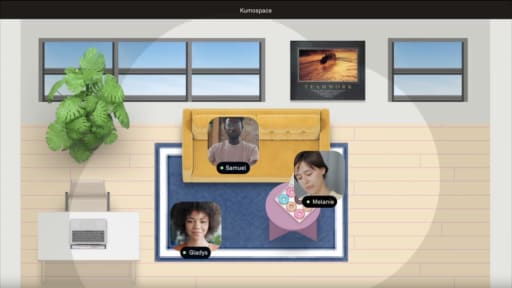
A virtual workspace is a persistent digital environment where a distributed team works alongside each other through the day, rather than a place they visit for scheduled meetings. Remote work isn't a temporary adjustment anymore. Distributed and hybrid teams are the default for a wide range of organizations, and the tools they use to collaborate shape everything from daily productivity to whether people actually feel connected to their colleagues.
The ten virtual workspaces below fall into three groups: spatial offices built for ambient presence, productivity suites built for documents, and project tools built for task visibility. Which group you need depends on where your team's friction actually sits.
Key takeaways
- Virtual workspace tools improve communication, collaboration, and team connection, helping remote and hybrid teams stay productive while supporting flexible work.
- The best platform depends on your team's needs, whether that's virtual office experiences, document collaboration, project management, or structured communication.
- Test a few tools with real workflows before committing, and evaluate factors like ease of use, integrations, customization, security, and pricing.
Why Virtual Workspaces Matter

Virtual workspace platforms do more than move meetings online. They recreate the everyday interactions of a physical office in a digital environment: seeing who is available, asking quick questions, or having spontaneous conversations between meetings. The best platforms go beyond replicating office logistics by creating spaces where collaboration and informal interactions happen naturally.
The practical benefits are real: lower overhead from reduced physical office space, access to talent regardless of geography, and flexibility over when and where people work. According to Upwork's workforce projections, an estimated 36.2 million Americans, roughly 22% of the workforce, were expected to work remotely by 2025. The tools organizations choose to support those workers matter.
What to Look for in a Virtual Workspace Tool
Three things drive most platform decisions:
Communication quality. Real-time messaging, video, and voice that actually work without constant technical friction. The goal is reducing the coordination overhead that makes remote collaboration feel harder than it should be.
Collaboration features. Project management, document sharing, screen sharing, and virtual meeting spaces. The strongest platforms integrate these rather than requiring constant context-switching.
Customization. Shaping a virtual workspace online through tailored room layouts, branding, and tool organization creates a sense of ownership that generic enterprise software rarely offers.
10 Virtual Workspace Tools Worth Knowing

Kumospace: A virtual office where users move avatars through customizable 2D spaces with spatial audio. Available in the browser and as desktop and mobile apps. Conversations happen through proximity, which enables the kind of spontaneous interaction that flat video grids eliminate. Includes team chat, video conferencing, screen sharing, and an online whiteboard. Customizable room layouts ranging from standard offices to event halls. Good for teams that want something closer to the feel of a shared physical space.
SpatialChat: Proximity-based audio in interactive, customizable environments, with multiple room types, background customization, and personalized offices. Positioned more toward events and workshops than daily office presence. Multiple room types to suit different uses, background customization, and personalized offices. A solid choice for teams prioritizing immersive virtual presence.
Gather: A pixel-art virtual office platform designed for hybrid and remote teams featuring proximity audio, customizable spaces, and interactive tools.
Happeo: A social intranet and knowledge management platform designed to centralize internal communications, news, and enterprise search. Works best for organizations that need a single hub for internal communication beyond just chat and meetings.
TimeCamp Planner: A task tracking and project management tool (formerly HeySpace) combining Kanban boards with direct team messaging.
Google Workspace: Gmail, Calendar, Drive, Docs, Sheets, Slides, Meet, and Chat in one integrated suite, with a free personal tier and paid business plans. The collaboration layer is tightly integrated: real-time co-editing, straightforward file sharing, and video conferencing without separate accounts. Strong choice for teams already in the Google ecosystem and for organizations that prioritize document collaboration.
Microsoft Teams: Chat, meetings, voice and video calls, and file sharing with deep integration across Word, Excel, PowerPoint, OneNote, SharePoint, and Outlook. Keeps work organized in channels and connects naturally to the rest of the Microsoft 365 suite. The most practical choice for organizations already running on Microsoft infrastructure.
Tandem: A virtual office built around impromptu calls and group chat rather than scheduled meetings. Worth trying for teams that find structured meeting culture isolating. Group chats, impromptu calls, and easy ideation with colleagues. For teams that find structured meeting culture isolating, Tandem's informal interaction model is worth trying.
Sococo: Virtual workspace with a map-based office layout, room-based collaboration through voice, video, chat, and screen sharing, and avatar status updates. Conference rooms, breakout spaces, and focus rooms give teams flexibility in how they organize different types of work. The visual office map is distinctive and gives a useful at-a-glance view of who's where.
NexGen Virtual Office: Simulated office environment with real-time status, video conferencing, and chat. Custom digital office layouts, voice and video collaboration, and a secure document-sharing system. Suitable for teams that want a structured virtual office with good file handling.
How to Implement One

Assess what your team actually needs. The right starting point is understanding how your team currently works and where the friction is. Are people struggling with spontaneous communication, document collaboration, or project visibility? The answer shapes which platform deserves the most weight. Check in individually with team members; what they experience day-to-day is more informative than org-level assumptions.
Compare features and pricing. Most of these platforms use tiered pricing. Map your must-have features to what's available at each price point before committing. Free trials are standard; evaluate each platform by running actual daily workflows during the trial period.
Nail down security and privacy. For teams handling confidential information, this isn't optional. Review each platform's privacy policy, check for end-to-end encryption where relevant, and verify data residency options if your organization has compliance requirements. Migrating off a platform after a compliance review fails costs far more than the review would have.
Where Spatial Virtual Workspaces Fit
Teams that prioritize collaboration beyond scheduled meetings may prefer Kumospace because it recreates many of the informal interactions that are difficult to achieve with traditional video conferencing tools. Its spatial audio technology allows conversations to begin and end naturally as participants move through customizable virtual office layouts, making it easier to ask quick questions, brainstorm with colleagues, or hold impromptu discussions without interrupting the entire team.
Unlike platforms designed primarily around meetings, Kumospace supports a persistent virtual workspace where employees can collaborate throughout the day. In addition to spatial audio, it offers features such as team chat, screen sharin, customizable office layouts, breakout areas, guest access, and integrations with common workplace tools. These capabilities make it suitable for remote and hybrid teams that want to combine structured meetings with more organic day-to-day collaboration.
How to Choose the Right Virtual Working Space
The right virtual workspace depends on your team's working style more than on any feature list, so start by naming where the friction actually is.
Kumospace and Gather are spatial virtual workspaces, built for teams that want ambient presence and conversation that starts without a calendar invite. Google Workspace and Microsoft Teams are productivity suites, better suited to organizations centered on document collaboration and structured communication. TimeCamp Planner and similar project tools fit teams where task visibility is the main gap.
Once you know which group you're in, compare features, security, integrations, and pricing against that specific problem rather than against each other. Then test two options with real work over two to three weeks. The platform that wins is usually the one people keep open without being asked.
Frequently asked questions
A virtual workplace is an environment that enables employees and managers to work remotely and connect via digital communication channels, allowing for a flexible working environment free of geographic boundaries.
Virtual workspaces offer many benefits, such as increased flexibility and productivity for workers, cost savings on commuting and physical office space, more market opportunities and higher profits, and an environmentally friendly solution. Moreover, virtual offices allow for a more cost-efficient approach to modern working.
Look for a virtual workspace solution that offers features such as seamless communication tools, collaboration tools, and customization and personalization options to get the most out of your workspace. With Kumospace, users can move between offices and meeting rooms, fostering natural and dynamic interactions. Teams can design their virtual workspace according to their preferences, with individual offices showing personality and working status. These create a more engaging and immersive virtual workspace beyond traditional solutions.
Virtual workspace tools allow teams to collaborate and communicate seamlessly by enabling features such as real-time chat, video conferencing, and document sharing. This allows team members to work together more effectively and efficiently.
When assessing your team's needs for a virtual workspace, consider their current state of remote working, work hours, and communication protocols, as well as individual check-ins to clarify expectations.