In today’s hybrid and remote workplaces, the distance between senior leadership and frontline employees often feels greater than ever. Information passes through multiple layers, losing nuance along the way. Strategic priorities get diluted, and employee concerns do not always reach the people who can address them.
Skip-level meetings are a practical antidote. A skip-level meeting is a structured conversation between an employee and their manager’s manager that skips one level in the hierarchy to create direct dialogue. When your boss’s boss sits down with you for a candid conversation, both sides gain insights that filtered reports and dashboards cannot provide.
This article offers step-by-step guidance on designing, running, and scaling skip-level meetings for teams ranging from 20 to 5,000+ people. You will learn how to prepare for these meetings, what questions to ask, common mistakes to avoid, and how to turn insights into real organizational improvement.
Key Takeaways
- Skip-levels should focus on understanding team dynamics and organizational health rather than performance reviews or escalation, and participants should come prepared with relevant topics and context.
- Leaders should create psychological safety by setting the tone early, listening more than they speak, thanking employees for candor, and following through on shared themes and actions.
- Feedback from skip-levels should be used to coach and support managers, not undermine them, and tools like Kumospace can help virtual meetings feel more natural and engaging.
What Is a Skip-Level Meeting?

A skip-level meeting is a structured conversation between an employee and a leader at least two levels above them, without the direct manager present. The term “skip-level” refers to skipping one organizational tier to facilitate more open dialogue and deeper insight.
Here is a concrete example. Imagine a software engineer named Alex who reports to an Engineering Manager named Jordan. Jordan reports to the Director of Engineering named Sam, who reports to the VP of Engineering named Taylor. In a skip-level meeting, Alex might meet directly with Sam or even Taylor, bypassing Jordan for that conversation.
Skip-level meetings take several formats depending on an organization’s size and culture:
- One-on-one sessions - 30 to 45 minute individual conversations that are ideal for deeper relationship building
- Small group sessions - Four to eight employees meeting with a senior leader, useful for surfacing shared team dynamics
- Virtual office hours - Open drop-in sessions held in tools like Kumospace, where employees can approach leaders in a low-pressure environment
It is important to differentiate skip-levels from other meeting types. One-on-one meetings with a direct manager focus on performance, development, and day-to-day operations. Town halls are broadcast-style company-wide updates. Performance reviews evaluate individual contributions. Engagement surveys gather anonymous quantitative data. Skip-level meetings occupy a unique space because they are personal, qualitative, and focused on organizational health rather than individual performance.
Skip-levels are most effective when they are part of an intentional communication system rather than random check-ins. When employees know these meetings happen regularly, they are more likely to prepare thoughtful feedback and trust the process.
Purpose and Benefits of Skip-Level Meetings
Think of organizational communication like a game of telephone. By the time information passes through three or four management layers, the original message is often distorted, sanitized, or lost entirely. Skip-level meetings short-circuit this problem by creating direct channels between frontline employees and senior leadership.
Benefits for Senior Leaders
When a senior leader relies solely on direct reports for information, they see the organization through a filtered lens. Skip-levels provide clearer insight into how strategy is actually landing, earlier visibility into risks before they escalate, and better decision making grounded in real context. Research cited by Mind Tools suggests that organizations using regular skip-level meetings report stronger leader visibility and connection with their teams.
Benefits for Managers
Middle managers sometimes worry that skip-levels will undermine their role. When implemented correctly, these meetings tend to have the opposite effect. Senior leaders gain context that supports more effective coaching, expectations become clearer, and managers receive support based on direct employee feedback rather than assumptions.
Benefits for Employees
For individual contributors, skip-levels create visibility with senior leadership that can be difficult to achieve otherwise. They offer a channel to share ideas or concerns that may not surface in day-to-day workflows and help employees better understand company strategy and how their work contributes to it. When employees feel heard by leadership, engagement and retention tend to improve.
Quantitative findings support these outcomes. Employee experience platforms such as CultureMonkey and PerformYard report higher satisfaction, stronger morale signals, and lower voluntary turnover among organizations that run skip-level meetings consistently, based on aggregated survey and engagement data.
What Skip-Level Meetings Are Not
Misunderstanding the purpose of skip-levels can damage trust and undermine middle managers. Before launching a skip-level program, it is essential to clarify what these meetings are explicitly not intended to accomplish.
Skip-levels are not performance reviews. They are not calibration conversations about individual ratings, compensation, or promotion decisions. If employees expect a skip-level to influence their review, or if leaders treat these meetings as evaluation sessions, psychological safety can disappear quickly.
Skip-levels are not escalation channels for secret complaints. These meetings should not become a way for employees to go around their direct manager with grievances. Feedback should be framed constructively and with context, focusing on patterns and systemic issues rather than personal complaints.
Skip-levels are not decision-making meetings. They are not status updates on specific tasks or projects. Senior leaders should not make operational decisions that bypass the management chain during these conversations.
|
Myth |
Reality |
|
Skip-levels are secret investigations into managers. |
They’re transparent conversations about team health. |
|
Leaders will fix all problems raised immediately. |
Leaders listen, synthesize themes, and address systemic issues over time. |
|
Employees should use them to complain about their boss. |
Employees should share constructive observations about what’s working and what isn’t. |
|
Skip-levels replace regular 1:1s with managers. |
They complement, not replace, the manager relationship. |
When both leaders and employees understand these boundaries, skip-level meetings become a great tool for building relationships across hierarchy levels.
Why Skip-Level Meetings Matter in Modern Organizations
Since 2020, distributed work, matrix structures, and rapid organizational change have made clear communication more challenging than ever. Leaders managing hybrid teams across time zones often hear only filtered messages through dashboards and the perspectives of their direct reports.
In organizations with three or more layers, leaders can easily become disconnected from ground-level realities. Skip-levels reveal blind spots that would otherwise remain invisible, such as misaligned priorities between teams, process friction slowing execution, unclear strategy causing confusion, or cultural issues affecting specific groups.
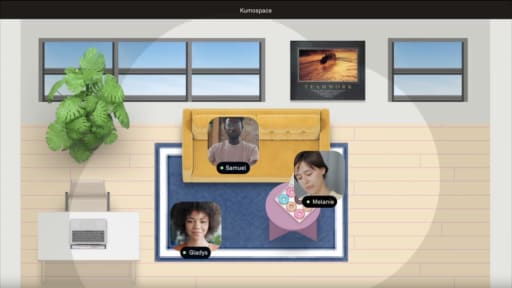
The role of skip-levels in building psychological safety is particularly important for remote-first companies. When employees work from home and rarely see senior leadership, it is easy to feel disconnected from the organization’s direction. Virtual spaces like Kumospace help bridge this gap by creating environments where skip-level conversations feel natural rather than formal. Leaders can “walk” through virtual rooms and engage employees in breakout areas that mimic casual office interactions.
HR leaders track specific engagement survey items that skip-levels directly influence, including “I have confidence in senior leadership,” “My manager is effective,” and “I feel a sense of belonging at this company.” When skip-levels are conducted well, these metrics improve. When they are neglected, employees can feel that upper management is out of touch with their reality.
How Often to Hold Skip-Level Meetings

There is no one-size-fits-all cadence for skip-levels. The right frequency depends on your organization’s size, growth stage, and the span of control at each level. What matters most is consistency and intentionality.
For managers-of-managers with small teams (under 25 indirect reports), aim for 30 to 45 minute one-on-one skip-levels with each person twice per year. This frequency is manageable and allows for meaningful relationship-building without overwhelming your calendar.
For larger organizations (50 to 200 indirect reports), rotate by pods, project teams, or departments. Meet each person at least once per year, supplementing with small-group sessions to increase coverage. You might hold skip-level meetings with one team each month on a rotating schedule.
For rapidly scaling startups, shorter 20 to 30 minute skip-levels each quarter work well for key roles or critical teams experiencing high change. The goal is maintaining connection during periods of intense growth.
Align skip-level cycles with existing rhythms in your organization. Scheduling them before or after H1/H2 performance review windows, or prior to OKR planning, ensures the insights you gather can inform upcoming decisions. Using scheduling automation and virtual spaces like recurring “drop-in” hours in Kumospace reduces administrative overhead while making these meetings more accessible.
Be careful with frequency. Too many skip-levels can create confusion about accountability and make managers feel bypassed. Too few lose relevance and fail to build trust. Finding the right meeting cadence is the most important step for long-term success.
How to Prepare for a Skip-Level Meeting
Good preparation prevents awkward, surface-level conversations and protects psychological safety for everyone involved. Both the senior leader and the employee should prepare, though their preparation looks different.
For leaders, the first step is defining the purpose of the cycle. Are you trying to understand team health, test whether strategy is landing clearly, or surface process friction? Being explicit about your goals helps you prepare questions and helps employees understand what kind of feedback is most useful.
Pre-communication is essential. Inform direct managers and employees at least one to two weeks in advance, clarifying the agenda, timebox, and what the meeting is not. This transparency prevents anxiety and signals that skip-level meetings are a normal part of how your organization operates.
A solid prep checklist for leaders includes reviewing the team charter and key metrics, scanning recent engagement data or survey results, understanding major projects or challenges the team is facing, and preparing five to eight open-ended questions tailored to the conversation.
Preparation Tips for Senior Leaders
Senior leaders should prepare five to eight core questions that fit their department and organizational context. A VP of Engineering will ask different questions than a Chief Customer Officer. Tailor your questions to surface the insights most relevant to your function.
Before the meeting, ask your direct managers for context and themes, but do not request detailed dossiers on individuals. You want background, not surveillance. Knowing that a team recently shipped a major release or is navigating a reorganization helps you ask informed questions.
Logistical preparation matters as well. Decide on the meeting format (one-on-one versus small group), the channel (in-person, Zoom, Kumospace), and ensure you have calendar buffers between meetings to process notes and decompress. Prepare how you will explain confidentiality, what you will do with feedback, and boundaries around topics to avoid misaligned expectations.
Finally, practice active listening techniques and maintain neutral body language, especially in video or virtual office environments. Your presence communicates whether this is truly a safe space for honest feedback or a performative exercise.
Preparation Tips for Employees
Employees should be encouraged, through HR or their managers, to jot down three to five topics before the meeting, such as what is working well, what is blocking them, ideas for improvement, and questions about strategy or career development.
Managers can help their reports frame feedback constructively. Instead of saying, “My manager is terrible at communication,” encourage phrasing like, “I have noticed our team sometimes gets conflicting priorities, and clearer communication from leadership would help us execute faster.” Focus on patterns and impacts rather than personal attacks.
Employees should also prepare questions for themselves. What do they want to understand about career paths? How are decisions made at the senior level? What is the leadership team most focused on this quarter? These questions demonstrate engagement and make the conversation bidirectional.
Reviewing recent team goals, such as quarterly OKRs or project milestones, helps employees speak concretely about progress and challenges. For virtual skip-levels, arriving early to the Kumospace room or video call to test audio and video reduces anxiety and ensures the meeting time is used productively.
How to Run a Skip-Level Meeting
Running an effective skip-level meeting requires attention to tone, trust, and consistent structure rather than rigid scripts. Think of it as a conversation, not an interrogation.
A simple structure works best:
- Set the tone and reduce anxiety (2-3 minutes)
- Build rapport and personal connection (5-7 minutes)
- Explore work experience and management (10-15 minutes)
- Discuss organization and strategy (5-7 minutes)
- Open the floor for questions (3-5 minutes)
- Wrap up with appreciation and next steps (2-3 minutes)
For virtual skip-levels, pay extra attention to presence. Camera on, distractions off, full attention on the employee. Informal tools like Kumospace reduce formality by creating spatial environments where conversation flows more naturally than in a flat video grid.
The most important principle is that the leader should talk less than the employee. Aim for roughly 70 percent employee speaking time and 30 percent leader time. You are there to listen intently and learn, not to lecture or defend.
Set the Tone and Reduce Anxiety
Open with a clear, friendly explanation of why the meeting exists and how the information will be used. Employees often feel nervous meeting with their boss’s boss, especially if it is their first meeting at this level.
Use specific phrases that reinforce safety, such as “This is not a performance review, and I am not here to evaluate your manager. I am here to understand your experience and learn what I can do to help our teams succeed.” Naming common fears directly can lower tension, for example, “People sometimes worry this means something is wrong. It does not. This is just how I stay connected to what is really happening.”
For virtual sessions, start with a brief orientation to the Kumospace room or video layout. Phrases like “Feel free to move around the space” or “You can grab a virtual coffee from the corner” make the meeting casual and accessible rather than formal and intimidating.
Watch the clock and leave enough time for questions and wrap-up. Starting with clear time boundaries, such as “We have 30 minutes today,” helps both parties relax into the conversation.
Build Rapport and Human Connection
Building relationships takes intentional effort, especially across hierarchy levels. Do not rush into business topics immediately.
Light but respectful icebreakers work well, such as:
- “What part of your role gives you the most energy right now?”
- “I heard your team shipped [project] last month. How did that feel?”
- “How are you finding remote work these days?”
Share something human about yourself as well. How you started at the company, what excites you about the current roadmap, or a challenge you are working through. Vulnerability from leaders encourages vulnerability from employees.
This stage is particularly important if the employee has not met a VP or C-level executive before. Small relationship investments pay off in the quality and candor of later feedback. For group skip-levels, use a quick around-the-room introduction pattern to balance airtime and help everyone feel included.
Invite Insight and Feedback About Work and Management
The core of the meeting should focus on the employee’s day-to-day experience, including wins, pain points, and team dynamics. This is where you gather information that filtered reports never capture.
Ask about enabling factors, such as tools, processes, and clarity, rather than just frustrations. “What helps you do your best work?” is often more revealing than “What’s broken?” Explore what support looks like, where communication barriers exist, and how decisions flow through the team.
Stay in a listening and clarifying mode. Resist the urge to immediately jump into problem solving. When employees share feedback, your job is to understand fully before responding. Ask follow-up questions such as, “Can you tell me more about that?” or “How often does this happen?”
When gathering feedback about managers, focus on behaviors and support rather than personality. Questions like “How does your manager help you grow?” or “What kind of feedback do you receive from your manager, and how often?” provide insight without putting the manager on trial.
When employees share difficult or vulnerable feedback, explicitly thank them. For example, “I really appreciate you being honest about this. It takes courage to share that with someone at my level.”
Discuss the Organization, Strategy, and Culture
Use part of the meeting to test whether strategic messages are landing clearly at the team level. Ask questions such as “What do you think our top priorities are this half?” or “How do you see your work contributing to our company goals?”
This segment often reveals miscommunication or confusion. If employees have diverse perspectives on company priorities, that is valuable feedback about communication effectiveness. Use this as an opportunity to correct misconceptions in a non-defensive way and share context behind major decisions.
Be honest about unknowns or evolving plans. Employees respect transparency more than false certainty. Saying “We’re still figuring that out” is perfectly acceptable when it is true.
This conversation often generates ideas for better all-hands presentations, FAQ documents, and internal communication improvements. Take notes on what employees wish they understood better, as it is valuable input for your communications team.
Open the Floor and Wrap Up with Appreciation
Reserve at least five minutes at the end for open questions, such as “Is there anything we haven’t talked about that you would like me to know, or anything you would like to ask me?”
Handle surprises calmly. If you hear frustrating or alarming information, resist the urge to react defensively. Simply thank the employee for sharing and note that you will follow up appropriately.
Before closing, summarize two to three key takeaways out loud. This confirms that you heard the employee accurately and demonstrates that their input matters. For example, “What I’m hearing is that the team feels really strong about X, but there is friction around Y and Z. Is that right?”
Close with sincere thanks, a reiteration of how feedback will be used, and realistic expectations about follow-up timelines. For example, “I cannot promise we will fix everything, but I will be sharing themes with [manager name] and our leadership team. You should see some updates in our next team meeting.”
Invite employees to continue raising issues through normal channels, such as their manager, HR, or anonymous feedback mechanisms, between skip-level cycles.
Sample Skip-Level Meeting Questions for Leaders

Having a curated question bank helps leaders prepare efficiently and ensures conversations stay productive. The questions below are organized by theme; select 5-7 per meeting based on your goals and the employee’s context.
For virtual skip-levels, consider sharing a few questions ahead of time via email or inside a Kumospace room description. This reduces pressure and gives employees time to prepare thoughtful responses.
Note that some questions work better for established relationships, while others are ideal for a first meeting with someone new.
Questions About the Employee’s Role and Experience
These questions explore workload, clarity, autonomy, and support:
- “What part of your work gives you the most energy right now?”
- “What is one thing that is working really well on your team?”
- “Where do you feel like you have the clarity you need, and where do things feel ambiguous?”
- “If you could change one thing about how your team works this quarter, what would it be?”
- “What tools or processes help you do your best work? What gets in the way?”
- “How balanced does your workload feel lately?”
Frame questions to invite nuance rather than binary yes or no answers. Phrases like “Tell me about…” and “How do you experience…” open up a richer conversation than “Do you like…?”
Questions About Managers and Team Dynamics
These questions focus on support and behaviors without inviting complaints:
- “How does your manager help you grow and develop?”
- “How often do you receive feedback from your manager? What is that experience like?”
- “How safe do you feel raising concerns or disagreeing with your team?”
- “What is an example of great leadership or collaboration you have seen recently?”
- “What could your manager do that would help you succeed?”
- “How well does your team handle conflict or competing priorities?”
Avoid wording that implies the manager is on trial. You are seeking to understand team dynamics, not to build a case against anyone. When employees share suggestions for improvement, note them without promising specific consequences.
Questions About the Organization and Strategy
These questions gauge understanding and surface communication gaps:
- “What do you think are our top 2-3 priorities as a company right now?”
- “How do you see your team’s work connecting to our broader goals?”
- “Where has communication from leadership been clear? Where does it feel confusing or missing?”
- “How does collaboration with [Product/Sales/Operations] feel from your perspective?”
- “What’s one thing we could do at the leadership level that would make your job easier?”
- “What question do you wish leadership would answer more clearly?”
Listen for trends across multiple skip-levels. One employee’s perspective is an anecdote; patterns across many employees are actionable insights.
Common Mistakes to Avoid in Skip-Level Meetings
Many organizations try skip-levels once, mishandle them, and then abandon the practice entirely. Understanding common pitfalls helps you avoid them and build a sustainable program that delivers continuous improvement.
The biggest risks include eroding trust with managers by conducting skip-levels secretly or framing them as investigations, over-promising actions you cannot deliver, treating meetings as venting sessions with no follow-up, using skip-levels to triangulate interpersonal conflicts, and defending decisions too aggressively instead of listening, which shuts down candor.
Another common mistake is selection bias. Do not only meet with high performers or outspoken individuals. Random or systematic coverage ensures you hear from a representative cross-section of your organization.
Undermining Managers (Even Unintentionally)
If skip-levels are launched without notifying managers, they may feel threatened or bypassed. This damages trust and makes managers defensive rather than supportive of the process.
Always inform managers of the purpose, format, and cadence before meeting their reports. Frame skip-levels as a way to support managers, not surveil them. Saying “I want to understand how I can better support you and your team” is very different from “I want to find out what is really going on.”
During skip-levels, refrain from contradicting managers’ decisions in the moment. If an employee raises a concern about their manager’s approach, listen and note it, but do not immediately side with the employee or promise to override the manager. Follow up privately with managers later through appropriate channels.
When sharing themes back with managers, focus on patterns rather than verbatim quotes. For example, “Several team members mentioned feeling unclear about priorities after our last reorganization” protects anonymity while providing actionable feedback. HR can coach leaders on language that reinforces manager authority while still taking employee input seriously.
Turning Meetings Into Complaint Sessions
Without structure, skip-levels can devolve into unproductive venting about specific individuals or isolated incidents. This creates a negative meeting experience for everyone and does not produce useful insights.
Gently steer conversations toward patterns, impacts, and ideas for improvement. If an employee starts venting about a specific incident, acknowledge their frustration and then redirect: “That sounds frustrating. I’m curious, is this part of a broader pattern, or was this a one-time thing?”
Do not diagnose or pick sides in conflicts during the meeting. Note issues for follow-up through proper channels. Ask about what is going well to balance narratives and recognize bright spots. For example, “You’ve shared some challenges. What is something that is working really well that we should protect or expand?”
Remind employees of normal escalation paths for urgent issues. Skip-levels are not meant to replace HR, ethics hotlines, or regular management conversations.
Failing to Follow Through
The fastest way to kill trust in skip-levels is to collect feedback and then visibly do nothing with it. Employees quickly learn whether these meetings matter or are just theater.
Block 10 to 15 minutes after each meeting to review notes and capture action items or themes while the conversation is fresh. Do not let insights disappear into a forgotten notebook.
Provide periodic “you said, we did” updates at team meetings or all-hands, aggregating feedback to preserve anonymity. For example, “In recent skip-levels, several people mentioned confusion about our new project prioritization process. We have created a FAQ document and will be holding a workshop next week to address this.”
Some feedback will not lead to change, and that is okay. But close the loop and explain why when appropriate. For example, “I heard concerns about our remote work policy. We reviewed this at the leadership level and decided to maintain the current approach because [reason]. I understand this is not the answer everyone hoped for, and I appreciate the candid feedback.”
Connecting follow-up to real organizational changes builds trust and ensures future skip-levels generate increasingly valuable insights.
Post-Meeting Follow-Up and Turning Insights Into Action

Individual skip-level conversations are valuable, but the real impact comes from synthesizing insights across multiple meetings and driving organizational improvement.
A simple post-cycle workflow keeps you organized:
- Synthesize notes from all skip-levels in the cycle
- Identify themes that appeared across multiple conversations
- Prioritize issues based on impact and feasibility
- Communicate back to employees, managers, and teams
- Support managers with coaching and resources to address feedback
Share anonymized patterns with your direct managers and HR business partners to co-design responses. Some issues require leadership action, others need manager-level intervention, and still others call for cross-functional collaboration.
Document outcomes in a lightweight way, such as shared documents, HRIS notes, or brief summaries. Avoid creating surveillance fears by keeping documentation focused on themes and actions rather than individual employee profiles.
Virtual collaboration spaces like Kumospace can host informal follow-up sessions or Q&A after a major skip-level cycle, keeping dialogue flowing between formal meetings.
Sharing Themes With Managers and Teams
When summarizing findings for your broader team, focus on the top three strengths you heard and the top three friction points that emerged. This creates a balanced narrative and gives teams clear areas to celebrate and improve.
Protect individual identities when feedback could be sensitive or traceable. In small teams, even phrases like “several people mentioned” can feel identifying. Use judgment about what to share and how to frame it.
Align skip-level themes with existing improvement workstreams. If feedback surfaces process friction, connect it to ongoing process redesign efforts. If employees want better tooling, link it to technology investment decisions. This ensures feedback drives action rather than creating parallel initiatives.
Give managers clear guidance on which issues they own, which belong to senior leadership, and which require cross-functional collaboration. Be transparent about timing, as some changes are quick wins while others will span multiple quarters. Managing expectations prevents frustration.
Supporting Managers With Coaching and Resources
Skip-level feedback should be used primarily to support and develop managers, not punish them. When patterns emerge around manager effectiveness, HR and senior leaders should design targeted interventions: training on giving feedback, delegation skills, or remote management best practices.
Offer one-on-one coaching with managers whose teams reported specific challenges. Frame these conversations around partnership and employee growth: “I heard some themes about communication clarity on your team. Let’s talk about how I can support you in addressing this.”
Anonymized examples from skip-levels can become realistic case studies for manager enablement programs. Real situations are more compelling than hypothetical scenarios in training.
Closing the loop with managers by letting them know what you heard and how you are supporting them builds their trust in the process. Managers who feel supported become advocates for skip-levels rather than skeptics.
Using Tools and Virtual Workspaces (Including Kumospace) for Skip-Level Meetings
Hybrid and remote work have made digital tools essential for scalable skip-level programs. The right technology can increase the productivity of these conversations and make them feel more human, even across distances.
Video calls such as Zoom, Teams, or Google Meet are the default for most remote skip-levels. They are familiar and reliable, but can feel formal and sometimes create “Zoom fatigue.” They work well for structured one-on-one conversations.
Phone calls offer simplicity and can feel less formal than video, but you lose visual cues that help build rapport and detect how an employee feels during the conversation.
In-person meetings remain the gold standard for building deep personal connections, but they are not always feasible for distributed teams or when leaders manage people across multiple offices.
Virtual office platforms like Kumospace occupy a middle ground. They create spatial environments where leaders can host recurring “executive coffee hours,” open-door sessions, or small-group skip-levels in a more relaxed atmosphere. Features such as spatial audio, virtual rooms, and avatar-based navigation reduce the formality of traditional video calls. One Fortune 500 company found that skip-levels conducted in virtual office spaces yielded 40 percent more candid feedback than traditional video equivalents.
Basic tech best practices for remote skip-levels include:
- Ensure a stable audio and video setup and minimize background distractions
- Use a private room or space to protect confidentiality
- Take notes in a secure document rather than recording unless you have explicit consent
- Schedule meetings at time-zone-friendly hours, rotating when necessary
- Test your setup before the meeting to avoid technical delays
HR or internal communications teams should centralize resources such as FAQs, sample questions, timelines, and guidance documents in a shared digital space. This consistency helps leaders across the organization hold skip-level meetings effectively and ensures employees know what to expect.
Conclusion
Skip-level meetings are a great opportunity to break down communication barriers between senior leadership and frontline employees. When done well, they build trust, surface honest feedback, and drive continuous improvement across your organization.
The benefits of skip-level meetings compound over time. As trust builds, conversations become more candid. As action follows feedback, employees engage more deeply. As leaders gain valuable insights, decision making improves.
Start by planning a pilot cycle with one department or team. Gather feedback on the process itself and refine your approach. Then scale across your organization with confidence.
Skip-level meetings are not just another calendar item. They are an investment in the relationships, transparency, and open communication that make organizations thrive. Block the time, prepare questions, and start building those connections today.
Frequently Asked Questions
A skip-level meeting is a formal one-on-one where a senior leader meets with employees who report to their own direct reports, essentially skipping a layer of management. Companies hold them to bypass informational filters, build trust with the frontline, and gain unfiltered feedback on organizational health and management effectiveness.
Managers should focus on open-ended questions such as, “What is currently the biggest bottleneck in your daily work?” or “If you could change one thing about our team’s processes, what would it be?” Questions should also gauge alignment, for example, asking if the employee understands how their work contributes to the company's broader strategic goals.
For most organizations, a quarterly or biannual cadence is the sweet spot to maintain a pulse on the team without creating meeting fatigue. In high-growth or rapidly changing environments, a monthly check-in may be more effective to ensure alignment and catch potential friction points early.
These practices improve employee engagement by making staff feel heard by senior leadership and providing them with direct access to career mentorship. For the organization, benefits include higher retention rates, identification of rising star talent, and the ability to spot systemic issues before they become crises.
Employees should prepare by identifying two to three key wins and a few constructive suggestions for process improvements that align with the company’s mission. It is also helpful to research the leader’s background and prepare strategic questions about the company’s long-term vision or industry trends to demonstrate high-level thinking.