The way tech teams work has changed. Between 2020 and 2026, companies moved from rows of identical desks to intentional environments where engineers, data scientists, and product managers come toxgether to solve problems that no single person could tackle alone.
A collaborative working space is exactly what it sounds like: a mix of physical and virtual environments designed for teams to build, decide, and ship together. This article explains what these spaces look like, why they matter for modern engineering and AI teams, and how tools like Kumospace and structured hiring practices support them. Founders, engineering leaders, and HR executives at high-growth AI startups will gain a practical framework for designing spaces that accelerate both productivity and hiring.
What Is a Collaborative Working Space?
A collaborative working space is any setting intentionally designed for people to come together to exchange ideas, make decisions, and build products. Unlike traditional office layouts with rows of identical desks or closed private offices, collaborative workspaces prioritize interaction over isolation.
What makes a space collaborative? Here are the defining characteristics:
- Shared surfaces and tools: Open tables, writable walls, and always-accessible whiteboards where teams can gather and discuss problems visually
- Collision points: Coffee bars, informal lounges, and standing areas placed where people naturally cross paths
- Flexible furniture: Modular desks and chairs that teams can reconfigure for different tasks
- Strong connectivity: Reliable Wi-Fi, high-quality AV equipment, and integrated video links so remote teammates feel present
- Acoustic management: Zones designed for different noise levels, from quiet focus pods to energetic brainstorming areas
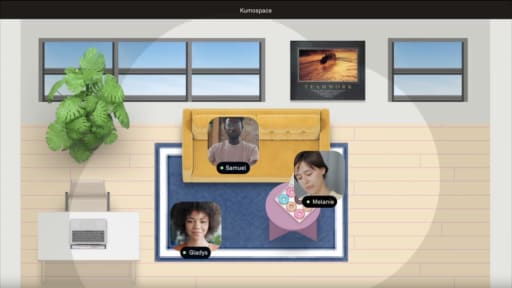
Consider a 15-person AI startup in San Francisco. Their compact physical office includes a shared project table, two phone booths, and a small lounge. Half the team works remotely from Toronto and Berlin. They use a Kumospace digital floor that mirrors their physical layout with a virtual café for casual chats, a project room for sprint planning, and breakout spaces for pair programming. The result is a collaboration space that works across time zones.
Why Collaborative Working Spaces Are Essential Today
AI, ML, and software engineering work is inherently collaborative. Complex systems require cross-functional teams, including backend engineers, ML specialists, product managers, and data scientists, working in tight loops. No one person holds all the context needed to build great products.

Here’s how the landscape evolved:
- 2020: The pandemic forced remote-first experiments at scale
- 2022: Hybrid work normalized as companies realized employees would not return to daily commutes
- 2023–2026: Offices repurposed from desk farms into collaboration hubs, used two to three days per week for high-bandwidth teamwork
Why startups lean on collaborative spaces:
- Faster onboarding: New hires absorb context by sitting alongside experienced colleagues rather than reading documentation
- Reduced process overhead: Quick hallway conversations replace lengthy Slack threads
- Better alignment: Sprint planning and architecture reviews work better when teams can see the same whiteboard
- Stronger culture: Connections formed in shared spaces translate to trust during high-pressure product pushes
A seed-stage AI company might use a coworking hub two days a week. Monday is sprint planning in a dedicated project room. Thursday is architecture review and demo day. The rest of the week, the team works remotely, staying connected through virtual collaboration spaces.
Core Types of Collaborative Working Spaces
Effective workplaces blend multiple space types instead of relying on a single open office concept. Collaborative spaces are activity-based rather than one-size-fits-all.
The main categories are:
- Inform spaces: Presentation areas for demos, trainings, and all-hands meetings
- Do spaces: War rooms for sprint execution, incident response, and tactical work
- Think spaces: Brainstorming zones for ideation and deep thinking
- Connect spaces: Social areas like cafés and lounges for serendipitous conversations
- Virtual environments: Platforms like Kumospace that replicate physical collaboration for distributed teams
The ideal mix depends on team size, product lifecycle stage, and the distribution of remote versus on-site employees. A 10-person seed startup needs a different ratio than a 150-person Series B company. Each of the following sections will describe what each space type looks like, what tools it needs, and how it supports specific workflows.
Spaces for Presenting and Informing
Inform spaces are optimized for one-to-many communication, such as demos, training, all-hands meetings, and investor updates. These are the spaces where a presenter shares ideas with a group.
Physical design elements:
- Tiered or amphitheater-style seating with clear sightlines
- Large displays (75”+ screens) visible from every seat
- Central stage or presentation area with good lighting
- Flexible seating that can expand for larger groups or contract for intimate sessions
- Acoustic treatment to ensure speakers are heard clearly
Technology requirements:
- High-quality cameras positioned to capture both the presenter and audience
- Ceiling microphones or portable mics for Q&A
- Recording capability for async viewing by remote teammates
- Integration with Kumospace or Zoom so distributed team members feel present
When to use:
- Product demos to stakeholders
- Architecture reviews where ML engineers walk through model decisions
- Cross-team tech talks and knowledge sharing
- Company all-hands and investor presentations
For AI and ML teams, these rooms need screens capable of displaying detailed dashboards, model visualizations, and live data. The environment should feel energizing but not overwhelming, with good lighting, subtle company branding, and acoustics that promote focus during presentations.
Spaces for Tactical Work and “War Rooms”

Do spaces are dedicated rooms for sprint execution, incident response, and any task where teams must see the same information simultaneously. These function as command centers for getting work done.
Layout essentials:
- Central collaboration table that can accommodate 4-8 people
- Wall-to-wall whiteboards or writable surfaces
- Large screens displaying persistent metrics (CI/CD dashboards, experiment results, candidate pipelines)
- Ergonomic chairs for extended sessions
- Easy access to power outlets and charging stations
The persistence principle:
Unlike meeting rooms that reset after each use, war rooms maintain context. Boards and notes stay in place for weeks during product pushes. Kanban boards track work in progress.
Technology requirements:
- Interactive displays for collaborative document editing
- Integrated video conferencing so remote engineers can “sit in” via Kumospace
- Timer apps for timeboxed discussions
- Shared docs accessible from any device in the room
Companies like Google use modular furniture in these spaces that teams reconfigure daily to match agile rituals.
Spaces for Brainstorming and Deep Thinking
Think spaces are informal, low-pressure zones for ideation, architecture sketching, and product strategy. They differ from formal meeting rooms because the goal is to reduce friction and encourage new ideas to flow.
Ambience and design:
- Softer lighting than work areas
- Comfortable couches, lounge chairs, or bean bags
- Writable walls and portable whiteboards
- Movable stools and lightweight furniture that groups can rearrange
- Analog tools readily available: markers, index cards, sticky notes, large canvases
Supporting hybrid brainstorming:
These spaces should accommodate both in-person and remote collaboration. Digital whiteboards like Miro or FigJam displayed on screens allow distributed teammates to join via Kumospace and contribute in real time.
Examples for AI startups:
- Prompt-engineering jam sessions where engineers explore different approaches
- Model evaluation brainstorms comparing accuracy, latency, and cost tradeoffs
- UX flow mapping for AI copilots and conversational interfaces
Keep these spaces uncluttered. Instead of dense process posters, use visual prompts such as problem statements, product north stars, and customer feedback quotes. The environment should encourage exploration rather than compliance.
Social, Cafe, and “Collision” Areas
Connect spaces are the modern equivalent of the office watercooler. These areas foster cross-team relationships and informal knowledge sharing, often more effectively than scheduled meetings.
Physical zones to create:
- Coffee bars with quality espresso machines
- Micro-cafes with comfortable booth seating
- Standing tables near high-traffic areas (staircases, elevator lobbies)
- Window-adjacent lounges with natural light
- Outdoor patios or balconies where weather permits
The serendipity factor:
When developers bump into data scientists, recruiters chat with founders near the coffee machine, and engineers share ideas about user feedback over lunch, unexpected connections happen.
Virtual collision zones:
Platforms like Kumospace replicate this with themed rooms such as a virtual cafe, rooftop hangout, or game room where remote team members can drop in for unscheduled chats. This is important for distributed teams who miss the organic interactions of physical offices.
Design principles:
- No meeting booking; these are drop-in only
- Comfortable seating that encourages people to linger
- Sound management to allow conversation without disturbing focus areas
- Visible snack and drink options including coffee, water, and healthy snacks
- Norms that encourage short, informal chats rather than extended work sessions
Private Focus Areas and Chillout Zones

Collaboration only works when balanced with areas for focused individual work and recovery. This is especially important for engineers handling deep technical tasks such as writing complex algorithms, reviewing code, or preparing for interviews.
Quiet rooms and phone booths:
- Small, enclosed pods for 1-2 people
- Sound isolation for calls and video meetings
- Clean desks with power outlets and monitor connections
- Booking systems that limit sessions to 60-90 minutes to ensure access
Chillout zones for recovery:
- Soft furnishings and comfortable seating
- Plants and natural elements that reduce stress
- Adjustable lighting (dimmer than work areas)
- Sometimes tech-free by design to encourage genuine breaks
- Good acoustics that create a sense of calm
Practical use cases:
- An ML engineer steps into a phone pod for a candidate technical screen
- A recruiter decompresses after back-to-back interviews
- A product manager needs 90 minutes of uninterrupted time to write a specification
These spaces should have minimal signage, calm imagery, and clear norms posted such as time limits and quiet expectations. They exist to serve employees who need a break from constant stimulation.
Meeting Rooms, Boardrooms, and Hybrid-Ready Spaces
Traditional meeting rooms support structured discussions, private conversations, and strategic planning. Boardrooms accommodate investor meetings, sensitive HR conversations, and executive offsites.
Design elements:
- High-back ergonomic chairs for extended sessions
- Controllable lighting with multiple settings
- Soundproofing to prevent confidential discussions from leaking
- Tables sized for the expected group (avoid oversized boardrooms for small teams)
- Air quality management for sessions longer than 60 minutes
Hybrid requirements are non-negotiable
|
Feature |
Purpose |
|
Plug-and-play AV |
No IT support needed to start a meeting |
|
Camera positioning |
Remote participants see everyone at the table |
|
Room booking systems |
Aligned with global time zones (SF, London, Bengaluru) |
|
Reliable platforms |
Consistent experience whether hosting 2 or 20 remote participants |
|
Screen sharing |
One-click access for presentations |
Common scenarios:
- Quarterly planning with distributed leadership
- Compensation reviews requiring privacy
- Cross-border team offsites blending in-person and remote executives
- Candidate final rounds where hiring committees need confidential discussion space
Virtual Collaborative Workspaces (e.g., Kumospace)

Virtual offices became a central part of collaborative workspaces for distributed teams. These platforms go beyond video calls and provide immersive digital environments where team members can interact, collaborate, and maintain the presence and spontaneity of working alongside colleagues.
Kumospace exemplifies this category. Teams create digital floors with distinct rooms and zones that mirror their physical offices: project rooms for sprint planning, cafes for casual conversation, and quiet areas for focused work.
Typical uses:
- Daily standups where avatars gather in a virtual circle
- Spontaneous drop-ins; just walk to a colleague’s desk
- Candidate interviews conducted in dedicated virtual rooms
- Cross-team social events and happy hours for fully remote teams
- Hackathons and hiring events with participants worldwide
Benefits over traditional video calls:
- Reduced isolation: Teammates see who is in the office and available
- Stronger presence: Spatial audio creates natural conversation dynamics
- Cross-timezone connection: Digital spaces remain consistent regardless of physical location
- Event hosting: Hiring events can accommodate global participants in dedicated virtual rooms
Organizations using platforms like Kumospace report faster onboarding and higher engagement compared to standard video conferencing. The spatial element creates a sense of community that static calls cannot replicate.
Tools and Technology That Make Collaboration Work
Furniture and layout alone aren’t enough. Software and hardware must be thoughtfully integrated to support each type of collaboration space.
Software categories to consider
|
Category |
Examples |
Purpose |
|
Project management |
Linear, Jira, Asana |
Track tasks and workflow across teams |
|
Async communication |
Slack, Notion, Loom |
Share ideas without requiring real-time presence |
|
Collaborative docs |
Google Docs, Confluence |
Real-time editing and documentation |
|
Code hosting |
GitHub, GitLab |
Version control and code review |
|
Virtual offices |
Kumospace |
Remote collaboration with spatial presence |
|
Digital whiteboards |
Miro, FigJam |
Visual brainstorming for distributed teams |
Hardware requirements:
- Interactive displays (75”+ with touch capability)
- High-quality webcams (4K for larger rooms)
- Noise-canceling microphones (ceiling arrays or portable)
- Multi-monitor setups for war rooms
- Portable devices for hot-desking and flex seating
Selection criteria:
- Budget constraints and total cost of ownership
- Security requirements (especially for AI companies handling proprietary models)
- Interoperability with existing systems (calendar, identity management, HR tools)
- Ease of use for non-technical staff like recruiters and office managers
AI startups have standardized on lightweight stacks: Slack for communication, Linear or Notion for project management, Google Workspace for docs, and Kumospace or similar for virtual presence. The goal is efficiency, using tools that work together without constant configuration.
Designing a Collaborative Working Space for Hybrid Tech Teams
If you’re planning an office or virtual hub for a team of 10–200 people using hybrid work patterns, here’s a step-by-step approach.
Phase 1: Needs Discovery (Weeks 1-2)
- Map current workflows: When do teams need to collaborate synchronously? When is async sufficient?
- Document time zones: Where are your employees located? When do overlapping hours occur?
- Identify role types: Backend engineers have different needs than recruiters or customer success
- Catalog pain points: What’s broken in current collaboration? Where do people waste time?
Phase 2: Zone Planning (Weeks 3-4)
Define activity-based zones using the framework covered earlier:
- Inform spaces: How many people attend your largest presentations?
- Do spaces: How many concurrent projects need dedicated war rooms?
- Think spaces: What’s the ratio of brainstorming to execution work?
- Connect spaces: What social rituals matter to your team?
Phase 3: Hybrid Integration (Weeks 5-8)
- Select a virtual collaboration platform (Kumospace or alternative)
- Design virtual spaces that mirror physical ones
- Establish norms: When are people expected in-person vs. remote?
- Create a plan for global events like hiring days or quarterly planning
Phase 4: Etiquette and Rollout (Weeks 9-12)
- Document space usage guidelines
- Train teams on new tools and technologies
- Run pilot sessions in each space type
- Gather feedback and iterate
Concrete example:
A 40-person AI company allocates Tuesday and Wednesday for in-person work at a coworking space. Sprint planning happens Tuesday morning in a booked project room. The rest of the week, teams collaborate via Kumospace with async handoffs through Notion. The form of work dictates the space, not the other way around.
How Collaborative Spaces Impact Hiring and Talent Strategy

Collaborative working spaces directly affect your ability to recruit and retain senior engineers and AI talent. In 2026, candidates evaluating companies look beyond compensation to assess how teams actually work together.
What candidates evaluate:
- Office layout and whether it supports deep work alongside collaboration
- Virtual culture for remote or hybrid roles
- Tools and technology used daily
- Whether the physical space reflects the company’s stated values
A cluttered, noisy open office signals one thing. An intentional collaboration space with focus pods, a well-designed cafe, and thoughtful virtual presence via Kumospace signals engineering quality and a culture that respects how work actually gets done.
How spaces support structured hiring:
- Dedicated interview pods for technical screens
- War rooms where hiring teams review profiles and discuss compensation
- Virtual rooms that mirror physical spaces for remote interview panels
- Quiet zones where candidates and interviewers can decompress between sessions
Practices that promote fair, transparent evaluation:
- Consistent environments across all interviews (lighting, acoustics, technology)
- Spaces equipped for bias-audited evaluations with standardized scoring
- Video recording capability for review by absent committee members
- Quick access to candidate materials in shared project rooms
When your space supports rapid, transparent decision-making, you can move from interview to offer faster, a critical advantage when competing for in-demand AI talent.
Future Trends in Collaborative Working Spaces
Looking forward, several developments will reshape how organizations think about collaborative environments.
Smarter offices:
- Sensor data tracking occupancy and utilization patterns
- AI-assisted scheduling that automatically books the right space type for each meeting
- Predictive maintenance that keeps AV equipment functioning before it fails
- Dynamic booking systems that learn team preferences
Evolution of virtual platforms:
Platforms like Kumospace will mature into persistent “digital campuses” integrated with:
- Calendar systems for automatic presence updates
- HR tools for onboarding and mentorship programs
- Project management platforms showing work status in spatial context
- Analytics dashboards tracking collaboration patterns across the world
Sustainability trends:
- Smaller permanent footprints with more flexibility
- Shared and on-demand spaces through coworking partnerships
- Reuse of existing buildings instead of new construction
- Energy-efficient technology that supports sustainability goals
Talent competition:
As AI hiring accelerates, companies will use collaborative spaces as a differentiator. Engineers who value autonomy, deep work, and high-quality collaboration will choose organizations with thoughtful workspace design. Companies that treat space as a strategic investment rather than a facilities decision will gain an advantage in attracting scarce AI and ML talent.
Conclusion
Collaborative working spaces, both physical and virtual, are now central to productivity, innovation, and successful hiring. The ideal workspace is not a one-size-fits-all template; it is a thoughtful balance of focus areas, social zones, tactical rooms, and virtual offices like Kumospace functioning together as a cohesive ecosystem. Founders and HR leaders at growing AI companies should start by auditing their current setup, observing where teams struggle to collaborate or focus, and identifying opportunities for improvement. From there, they can plan concrete changes over a 90-day period, such as reconfiguring a space type or implementing a new virtual collaboration tool. Finally, it is important to connect workspace design to hiring, ensuring that interview loops, debriefs, and candidate experiences are fully supported. When workspace strategy and talent strategy align, both become far more effective.
Frequently Asked Questions
Collaborative workspaces are designed with intentional flexibility that supports changing activities and lets people choose the best space for their needs at any given time, while standard open-plan offices often become overly distracting and lack designated areas for different work modes.
Modern offices need rooms for virtual collaboration, flexible meeting areas that adapt to varying team sizes, activity-based workspaces with zones for different tasks, communal tables for impromptu meetings, and informal seating areas that foster spontaneous conversations.
Employees engaging in collaborative work report improved performance and achieve faster project completion times.
The best office design balances collaboration with quiet, focused work by creating acoustically intelligent zones with soundproof pods, dedicated quiet areas, activity-based workspaces, and visual or physical separations that allow employees to seamlessly transition between collaborative activities and individual deep work.
Technology enables hybrid collaboration through 360-degree cameras, interactive whiteboards for real-time co-editing, AI-powered meeting platforms with automatic transcription and translation, cloud-based unified communication systems that integrate messaging and video, and AR capabilities that let remote attendees interact with 3D models for immersive teamwork.