Workplace connections are not a “nice to have.” They are a measurable advantage that shows up in retention, velocity, and innovation.
Replacing a senior ML engineer typically costs 1.5-2 times their annual salary when factoring in recruiting, onboarding, and lost productivity. A single preventable departure from a 15-person team can set back a product roadmap by months. Connected employees stay longer because they have reasons beyond compensation to remain.
Research consistently shows that high-connection environments yield psychological safety, resilience, high engagement, and lower turnover. Low-connection environments correlate with stress, burnout, low productivity, and attrition spikes.
Benefits break down across three levels:
Individual benefits:
- Reduced burnout through peer support and sustainable pace
- Clearer career paths when mentoring and feedback are consistent
- Higher job satisfaction from meaningful relationships at work
- Better mental health from reduced isolation
Team benefits:
- Faster decisions when trust exists and context is shared
- More innovative ideas when people feel safe to propose experiments
- Improved problem solving through diverse perspectives and open communication
- Stronger knowledge sharing that prevents single points of failure
Company benefits:
- Lower voluntary attrition, especially among high performers
- Stronger employer brand in a competitive talent market
- Faster onboarding when new hires have buddies and clear rituals
- Better execution when teams collaborate across functions
|
Disconnected Teams |
Connected Teams |
|
High voluntary attrition |
Strong retention |
|
Slow onboarding (4+ months) |
Fast ramp-up (6-8 weeks) |
|
Information hoarding |
Knowledge sharing culture |
|
Decision bottlenecks |
Distributed ownership |
|
Burnout and isolation |
Psychological safety |
|
Candidate hesitancy |
Strong offer acceptance |
The following strategies form a playbook that can be implemented within a quarter by a startup or engineering organization of 10-200 people. Each subsection covers one approach with concrete examples, especially tailored to remote and hybrid engineering teams working on AI and ML products.
These strategies are complementary, not sequential. You do not need all 10 at once. Assess your current gaps, such as onboarding friction, cross-team silos, or isolation among remote workers, and prioritize 3-5 that address your biggest pain points.
1. Create Intentional Social Interactions (Not Just More Meetings)
Random Zoom happy hours do not build connections. They become obligations people avoid. Effective interaction is intentional, low-pressure, and structured with optional attendance.
Effective formats include:
- Weekly virtual coffee chats: 20-minute rotating pairs or trios, scheduled automatically through tools like Donut
- Engineer circles: Small groups of 4-6 engineers from different teams meeting biweekly to discuss non-work topics or share side projects
- Demo + donut sessions: Monthly gatherings where one team demos recent work, followed by casual conversation
- Code show-and-tell Fridays: 30-minute sessions where engineers share interesting technical problems they solved that week
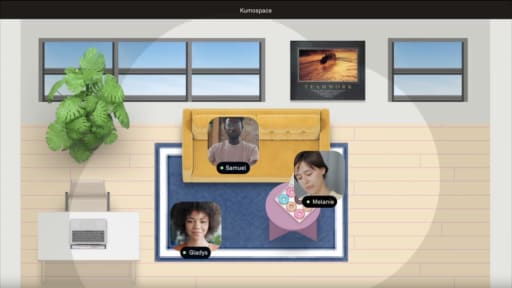
Kumospace excels here because its spatial audio and virtual rooms simulate the serendipity of office hallways. Team members can walk between rooms, have sidebar conversations, and drop into casual spaces, making social interaction feel less performative than scheduled video calls.
Recommended cadence:
- 1 recurring social touchpoint per week (15-30 minutes, same day each week)
- 1 slightly larger event per month (demo day, Q&A with founders)
- Voluntary attendance, but visible leadership participation signals importance
The goal is creating opportunities for human connection without adding meeting burden. When employees feel connected to teammates on a personal level, they collaborate more effectively on work.
2. Encourage Open and Frequent Communication
Building connections requires effective communication that goes beyond project updates. Team members need context about why decisions are made, not just what was decided.
Key rituals to implement:
- Weekly all-hands, 30-45 minutes, where leadership shares priorities, wins, and upcoming changes
- Documented decisions: Every significant decision (whether architectural, product, or organizational) gets written down in a central knowledge base
- Structured 1-1s: Engineers and managers meet every 1-2 weeks with consistent agendas covering blockers, career growth, and feedback
Why context matters:
For example, if leadership shifts focus from a chatbot feature to LLM reliability work, engineers need to understand the reasoning. Honest communication about trade-offs builds trust and engagement.
Tooling recommendations:
- Slack or Microsoft Teams for async communication with clear channel organization
- Kumospace or Zoom for live discussions and social interaction
- Notion, Confluence, or similar for decisions, roadmaps, and documentation
Specific practices that encourage open communication:
- Publish written pre-reads for major decisions so people can contribute asynchronously
- Maintain “decision logs” that capture what was decided, why, and who was involved
- Set explicit response-time expectations (e.g., “async messages should be answered within 24 hours during business days”) to reduce anxiety
When employees feel they have access to honest communication about company direction, they feel valued and connected to the mission.
3. Promote Cross-Team Collaboration (and Break Down Silos)

Silos are connection killers. When the ML team never talks to the data engineering team, knowledge hoards, decisions slow down, and people feel isolated within their pods.
Practical mechanisms to promote cross-functional projects:
- Cross-functional project teams: Pair an ML engineer, data engineer, and product manager to tackle a specific goal, such as improving chatbot latency
- Rotating sprint demo ownership: Each sprint, a different person from another team runs the demo to expose them to broader context
- Cross-team incident reviews: After incidents, engineers from multiple teams review what happened and share ideas for prevention
- Guest engineer stints: Engineers spend 1-2 sprints embedded with another squad to learn systems and build relationships
Kumospace supports this through persistent project rooms where cross-functional teams can drop in, co-work, and resolve blockers quickly. Instead of scheduling another meeting, engineers can walk over to the shared room and ask a question.
Implementation checklist:
- [ ] Identify one cross-functional project per quarter that requires multiple teams
- [ ] Assign clear ownership and timelines
- [ ] Create a shared channel and virtual room for the project
- [ ] Celebrate wins visibly in all-hands to reinforce collaboration
For small AI startups, cross-team collaboration prevents dangerous knowledge concentration around key models, pipelines, or infrastructure. When only one person understands the training pipeline, you create a single point of failure, and that person often has burnout.
4. Build a Culture of Trust, Respect, and Psychological Safety
Psychological safety means people can say “I don’t know,” flag model risks, or push back on unrealistic deadlines without fear of retaliation. It is the foundation for meaningful relationships and genuine interest in each other’s work.
Behaviors for engineering leaders:
- Admit when an architectural decision was wrong and explain what you learned
- Thank people publicly for raising concerns about model bias, security vulnerabilities, or technical debt
- Avoid blame in postmortems and focus on systems, not individuals
- Model vulnerability by sharing your own mistakes and uncertainties
Rituals that reinforce psychological safety:
- Blameless incident reviews: Every incident review starts with “We are here to learn, not to blame”
- Failure Fridays: Monthly sessions where teams share what did not work, experiments that failed, features that flopped, or assumptions that were wrong
- Anonymous Q&A before all-hands: Collect questions anonymously so people can ask what they are afraid to ask publicly
Language leaders can use:
- “That is a great question. I do not know the answer, but let us find out together.”
- “I appreciate you flagging this risk. What do you think we should do about it?”
- “I made a mistake on [specific decision]. Here is what I would do differently.”
5. Make Recognition and Feedback Part of Everyday Work
Recognition is one of the simplest ways to build employee connections. When people feel valued for their contributions, they engage more deeply and stay longer.
Lightweight recognition practices:
- Shoutouts in Slack: A dedicated #wins or #kudos channel where anyone can recognize a colleague
- Wins of the week: A standing slide in all-hands where team leads highlight notable contributions
- Micro-recognition for invisible work: Explicitly thank people for thorough code reviews, updated documentation, and mentoring which is work that often goes unnoticed
Recognition should be frequent and specific. “Great job on the project” is less impactful than “Your refactor of the inference pipeline reduced latency by 200 milliseconds and unblocked the product launch.”
Peer-to-peer recognition matters:
In distributed teams, managers cannot see every contribution. Peer mentoring and peer recognition fill the gap. Encourage team members to recognize each other rather than waiting for top-down acknowledgment.
These rituals can be started within one sprint without a new budget. The return on investment in terms of morale and retention is substantial.
6. Invest in Mentoring, Coaching, and Peer Support

Mentorship programs create connected employees by providing structured relationships focused on professional growth and career development. They are especially critical for onboarding and retaining early-career engineers.
Formats that work:
- 1:1 mentoring: Senior or staff engineers paired with early-career engineers for monthly or biweekly conversations
- Peer-coaching circles: Small groups of engineers at similar levels meeting regularly to discuss challenges and share ideas
- Buddy programs: Every new hire is assigned a buddy for their first 90 days—someone outside their direct team who can answer “dumb questions” and provide context
Onboarding example:
Every new AI engineer is paired with a buddy for their first 12 weeks. They meet weekly in a virtual environment for 30-minute check-ins. The buddy introduces them to key people, explains unwritten norms, and helps them navigate their first projects. After 90 days, the relationship becomes optional, but many pairs continue meeting.
Structure matters:
Mentoring can be informal, but it needs clear goals, a consistent check-in cadence, and a safe space to discuss career development rather than just current tasks. Without structure, mentoring relationships fade.
7. Reduce the Digital Divide in Remote and Hybrid Teams
Hybrid workplaces can accidentally create two classes of employees: those who happen to work in person and those who are remote. The in-office group hears hallway conversations, joins impromptu whiteboard sessions, and builds stronger connections simply through proximity.
Consequences of the divide:
- Remote engineers miss hallway decisions and feel out of the loop
- In-office employees get more face time with leadership and more visibility
- Lonely employees disengage and eventually leave
- Knowledge clusters around in-office groups, creating information asymmetry
Remote-first practices that level the playing field:
- Everyone dials in individually: Even if five people are in the office together, they join meetings from their own devices so remote participants aren’t watching a conference room blob
- Decisions documented asynchronously: Major decisions are written down and shared, not just discussed in person
- All social events have virtual equivalents: If there’s an in-office happy hour, there’s also a Kumospace social room for remote team members
Virtual collaboration platforms can help hybrid workers by giving everyone the same access to spontaneous chats, team rooms, and social spaces regardless of location. Remote engineers can “drop by” a colleague’s virtual desk just like walking over in an office.
Pulse surveys:
Survey remote employees quarterly with short, focused questions:
- “I feel included in important decisions” (1-5 scale)
- “I have opportunities for social interaction with colleagues” (1-5 scale)
- “I know what’s happening across the company” (1-5 scale)
Then act visibly on the feedback. Publish what you heard and what you’re changing.
8. Give Employees a Real Voice in Culture and Decisions
Connected teams are built on mutual respect, and respect means actually listening to employee input, not just collecting it in surveys that go nowhere.
Mechanisms for gathering insights:
- Regular anonymous surveys: Quarterly pulse checks on engagement, connection, and concerns
- Open roadmap reviews: Product and engineering roadmaps shared company-wide with opportunities for questions and input
- Request for comments processes: For significant engineering changes, anyone can comment, ask questions, or propose alternatives
- Feedback sessions after launches: Post-launch retrospectives that include all contributors, not just leads
Example:
A startup planning to adopt a new LLM inference platform runs a two-week request for comments period. Any engineer can review the proposal, comment on trade-offs, and suggest alternatives. The infrastructure team addresses every comment, either incorporating feedback or explaining why they went a different direction. Engineers feel heard even when their specific suggestion is not adopted.
Closing the loop:
The most important step is publishing what you heard and what you are changing as a result. Without this, employees report that feedback feels performative. “You said X was a problem. Here is what we are doing about it” reinforces that voices matter.
Practical rituals:
- Monthly or quarterly AMA sessions with founders
- Rotating voice of the engineer representative in leadership meetings
- Visible action items from survey results, tracked and reported on
9. Prioritize Well-Being and Sustainable Pace

There is a direct link between burnout and disconnection. Exhausted engineers withdraw from teammates, skip social events, and avoid communication. They become lonely employees even when surrounded by colleagues.
Concrete policies that support employee well being:
- Focus hours: Blocks of meeting-free time (e.g., 9 AM - 12 PM daily) for deep work
- No-meeting days: One day per week with no scheduled meetings for the entire organization
- Sane on-call rotations: Distributed fairly, with clear escalation paths and compensation for off-hours work
- Clear boundaries on weekend work: Incidents are emergencies; feature work is not
Mental health and wellness supports:
- Stipends for therapy, gym memberships, or wellness apps
- Protected time off after intense launches or incident responses
- Managers trained to recognize burnout signals and intervene early
Using virtual spaces for low-pressure connection:
Virtual platforms can host quiet co-working rooms where people work alongside each other without talking, simulating a library or coffee shop atmosphere. Some teams create meditation or decompression spaces for breaks. Walk-and-talk catchups, where two people take a call while walking outside, also support work-life balance.
Acknowledging startup reality:
High-growth startups move fast. That is not changing. But sustainable practices improve throughput over time by preventing burnout-driven attrition and the productivity loss that comes with exhausted teams. A team that maintains a sustainable pace for 18 months outperforms a team that sprints for six months and burns out.
10. Embed Diversity, Equity, Inclusion, and Belonging (DEIB) into Everyday Work
Belonging is essential to genuine connection. People must feel safe, seen, and feel valued across identity, background, and geography. Without belonging, other connection efforts fall flat.
Concrete steps:
- Inclusive interview panels: Multiple perspectives evaluating candidates, not just one person’s judgment
- Structured interviews: Consistent questions and rubrics to reduce bias and ensure fair evaluation
- Accessible documentation: Written content that works for non-native English speakers, neurodivergent team members, and those in different time zones
- Global-friendly meeting times: Rotate meeting times so the burden of inconvenient hours does not always fall on the same regions
ERGs and interest-based groups:
Groups can meet in virtual spaces, for example women in ML, first-time founders, or international employees. These groups create safe spaces for connection among people with shared experiences and strengthen the sense of belonging across the entire organization.
Regular equity reviews:
Review promotion, pay, and recognition data for equity patterns. Share high-level findings with employees for transparency. When people see that the company takes fairness seriously, trust increases.
Connection to hiring:
Fair, bias-audited hiring sets the expectation that the company values fairness. Candidates from underrepresented backgrounds often look for signals of genuine inclusion, not just stated company values. Structured processes and diverse interview panels demonstrate that commitment.

Connection needs evolve as engineers move through their tenure. A day-one hire needs different things than a two-year veteran considering a promotion.
Recruiting stage:
- Salary transparency so candidates can make informed decisions
- Clear expectations about role, team, and growth opportunities
- Multi-person interviews that let candidates experience the team dynamic
Onboarding (first 90 days):
- Structured schedules with clear daily and weekly rhythms
- Buddy assignments: someone outside the direct team to answer informal questions
- First-week meet-and-greets in Kumospace or similar virtual environments
- 30/60/90-day connection checklist:
- [ ] Met all teammates 1:1
- [ ] Joined at least one social event
- [ ] Understands company priorities and roadmap
- [ ] Has submitted first code/contribution
- [ ] Has attended all-hands and asked at least one question
Growth (year 1-2):
- Recurring career conversations focused on development, not just performance reviews
- Internal mobility opportunities to switch teams or take on new challenges
- Involvement in cross-functional projects to stay connected to broader company direction
- Visible recognition for contributions and professional growth
Career progression:
- Clear promotion criteria documented and accessible
- Mentoring relationships with senior or staff engineers
- Opportunities to mentor others, creating a continuous learning culture
- Involvement in hiring by meeting candidates and representing company culture
Blueprint summary:
|
Stage |
Connection Priority |
Key Rituals |
|
Recruiting |
Transparency, team exposure |
Multi-person interviews, salary disclosure |
|
Onboarding |
Belonging, context |
Buddy system, structured schedule, 30/60/90 checklist |
|
Growth |
Development, visibility |
Career conversations, cross-team projects |
|
Progression |
Impact, mentorship |
Promotion clarity, mentor/mentee relationships |