A remote culture health check is a one-week audit of your calendars, channels, and decision records that tells you whether your remote culture is working. Most culture breakdowns trace to one cause: nobody wrote down what happens synchronously versus asynchronously, so people default to old office habits.
You can usually see it before you can name it. Half your team goes quiet in the shared channels and stays constantly busy in DMs and side calls. Those are remote culture red flags, and they surface weeks before anything reaches an engagement score or an exit interview. By the time most leaders notice, they reach for surveillance software or mandatory office days, which make the pattern worse.
Key Takeaways
- The earliest sign of a broken remote culture is where conversations go: important work moving into DMs and side calls shows up in communication patterns long before it reaches retention numbers or engagement scores.
- Most remote culture problems trace back to one root cause: leaders never write down what should happen synchronously versus asynchronously, so everyone invents their own rules and defaults to copying old office habits.
- Reaching for surveillance software, mandatory cameras, or forced office days is itself a red flag; a one-week audit of the calendars, channels, and decision records you already have reveals more than any engagement survey.
Why Remote Culture Breaks in the Same Few Ways

Most remote-first company mistakes stem from treating remote work as a cosmetic perk instead of redesigning how the organization makes decisions and communicates. When Gartner surveyed 800 global HR executives in March 2020, 88% said their organizations had encouraged or required employees to work from home, and most did it under emergency conditions, replicating office-first schedules over video calls. Although full-time remote work rates declined from pandemic peaks, many distributed organizations continue running on the hasty communication norms established in 2020.
Leaders often underestimate how quickly informal office cues disappear in remote work, creating culture drift and inconsistent workplace norms across distributed teams, whether that's a company, a university department, or an agency. The physical cues that once carried context (a whiteboard sketch, a hallway aside, a glance across the table) don't translate to a fully remote environment, and without deliberate replacement, they simply vanish. Many of the mistakes leaders make going remote are structural: no written cultural foundation, no async standards, and proximity bias baked into promotion criteria. These recur with every new hire until the underlying system changes.
Signs of a Broken Remote Culture

Each sign below is visible within a week in data you already hold: calendars, Slack or Teams archives, email patterns, meeting notes, and project boards. One sign alone means little, and sometimes has an innocent explanation. Three or more together is a pattern worth investigating, and that pattern tells you more than any engagement survey could.
Your calendar looks like an in-office company's
Pull up a shared calendar for any remote team this week. If you see back-to-back video calls across a 9-to-5 block, daily standups for every team, and frequent "quick syncs" that run 30 minutes, you're looking at an office-first schedule draped over remote work. This pattern often signals a deeper mistake: treating remote work as meetings over video instead of designing for asynchronous communication across time zones. If your recurring meetings always favor headquarters hours while team members elsewhere consistently join at 7 a.m. or 10 p.m., that's a specific red flag, and after-hours activity like this can signal overwork rather than dedication.
An alternative explanation is a genuine crunch period around a launch or audit. Check whether the pattern persists past that milestone week. If it does, your calendar is telling you that your company still runs on physical-presence assumptions even though nobody is physically present.
Important decisions live in chat threads and people's memories
Open your project channels, email, and task tools. Search for the last three significant decisions your team made: a product direction change, a vendor choice, a hiring threshold. Can you find a written record of the rationale, the alternatives considered, and who made the call? If those details are scattered across chat history, recordings nobody rewatches, or one person's memory, you have a classic remote-first pitfall. Without a documented path forward, new hires and anyone outside the original crew can't reconstruct why choices were made, which erodes trust because it creates an inner circle who "just know" and everyone else who has to guess.
In very small teams, ad hoc decisions can hold for a while. The break point depends less on headcount than on the frequency with which team members require context they were not present to receive. Run a quick test: ask someone who joined in the last six months to find the rationale behind one significant decision, and time how long it takes. If it requires more than an hour of searching or asking around, your decision documentation norms are weak.
Promotion, visibility, and opportunities cluster around people you see or hear from most
Proximity bias translates into remote work more easily than most leaders expect. Compare the list of people who present in all-hands meetings or get stretch assignments with the list of top contributors in your project tools. If those lists diverge, and especially if the favored group shares your time zone or communication style, you're looking at a remote-first company mistake. The pattern is measurable elsewhere too: an analysis of workforce data found that people working from home were promoted 31% less frequently over the past year than office-based peers. When Vista went remote-first in August 2020, it began hiring well beyond the commuting radius of its old hubs, and global hiring of women into people-leader and managerial roles rose 233% between 2019 and 2022. Vista credits the wider hiring map, so read it as one company's result rather than proof about evaluation criteria.
A single exceptional performer can skew impressions, so look for patterns across at least a year of reviews and promotions. If the pattern tracks by location, time zone, or demographic group, it's worth reviewing with HR or counsel.
Slack, Teams, or Discord feel quiet, but side channels are noisy
Low traffic in public channels combined with high DM volume and frequent small-group calls is visible evidence that people aren't working in the open. This connects directly to psychological safety: when people fear judgment or conflict, they avoid open debate in shared spaces and move meaningful work into private conversations that new team members never see. An innocent explanation exists, since a team legitimately handling sensitive client data can't discuss it in broad channels. Distinguish between content constraints and culture habits by checking whether celebrations, recognition, and routine questions also move into private spaces. If they do, the pattern signals a remote culture issue, not a compliance requirement.
People rarely ask for help or challenge ideas in public
Review the last month of messages and meeting notes and count the explicit requests for help or constructive disagreements that appear in open forums. If the count is near zero but outages, delays, or rework still happen, silence is masking problems rather than reflecting smooth operations. An absence of visible questions in a remote team often points to low psychological safety, fear of slowing others down, or a leadership style that rewards "heroes" who struggle silently. Notice your own reactions, too: do you respond faster and more warmly to people who "just handle it" than to those who surface issues early? If so, you're training the team to hide problems. That's not a personal failing so much as a structural pull that affects most leaders, and recognizing it is the first step toward changing it.
New remote hires still feel lost in week three
Concrete signals appear in onboarding feedback and early one-on-one notes: new employees asking "where is this documented," repeatedly pinging the same person for basic context, or unable to explain team norms like meeting expectations or decision rights by the end of week two. This connects to the cultural-foundation problem: leaders assume the early crew will "show them how we do things," but in remote environments there's no shared physical space to transmit culture implicitly. When norms are tacit, every new hire learns a slightly different version of how things work, and the result is inconsistent subcultures across teams and time zones. Some confusion is normal in week one, but if by week three a fully remote hire still can't explain the basics, the system is failing them, and failing you.
Remote Culture Health Check: Diagnostic Table
Match what you observed this week to the row it fits, then run the intervention in the third column before changing anything else.
|
Observable Sign |
Likely Underlying Cause |
First Intervention |
|
Most work conversations happen in DMs, not public channels |
Low psychological safety or no norm for working in the open |
Leaders post one decision or question per day in a public channel and respond to others there first |
|
Back-to-back meetings fill the 9-to-5 block with no async blocks |
Office-first schedule copied to remote; no async defaults |
Cancel or convert the two lowest-value recurring meetings to written updates this week |
|
New hires can’t find rationale for recent decisions after searching for an hour |
Decisions are undocumented; context lives in people's heads |
Add a three-bullet decision summary to the shared doc or channel after every significant call |
|
Promotions and stretch assignments cluster in one time zone |
Proximity bias in evaluation; visibility rewarded over output |
Review last year's promotions by location and time zone with HR; define impact in written artifacts |
|
After-hours messaging spikes regularly, especially across time zones |
Absence of explicit response-time norms across time zones |
Draft and share expected response windows; make clear that off-hours messages don’t require same-day replies |
|
Peer recognition is rare or only happens in private |
Absence of structured habits or public forums for peer recognition |
Start a weekly public shout-out thread; leaders post first to model the behavior |
|
Team members rarely challenge ideas or ask for help publicly |
Fear of judgment; psychological safety is low |
Explicitly invite dissent in the next team meeting and thank the first person who pushes back |
|
Onboarding feedback includes "I don’t know who owns X" repeatedly |
No communication guide; cultural foundation is implicit |
Write a one-page "How we communicate" doc and include it in onboarding within two weeks |
|
Communication transparency is low: critical information is siloed in leadership channels |
Decision rights unclear; information asymmetry |
Move recurring leadership updates to a channel all team members can read |
|
Calendar shows meetings scheduled outside stated work hours for remote workers in other zones |
HQ-centric scheduling; time zone equity not prioritized |
Rotate meeting times quarterly or record and share notes for asynchronous access |
Practical Fixes for Common Remote-First Pitfalls
Rewrite how you run recurring meetings
Changing the agenda, participants, and default outcome of your core team meetings can fix several of these mistakes without a purchase or a reorg. Cut or convert status meetings into written async updates, reserve live calls for decisions or genuinely complex topics, and always end with a documented "who does what by when." Rotate facilitation so no single voice dominates, and share notes in a central space within 24 hours, treating recordings as a backup rather than the primary record. This works best when leadership models it first; if upper management still runs all-day syncs, team leads will copy the behavior regardless of what's written down.
Make decisions and rationales visible by default
Build the habit that every major decision gets a short written summary posted in a shared doc or channel, covering context, options considered, and the path chosen. Leaders should model this first, especially for cross-team decisions, and link decision notes from relevant tickets or project boards so future hires can reconstruct how trade-offs were handled. If people resist writing things down, start with a three-bullet template: what was decided, why, and what was ruled out. This depends on someone maintaining the habit for at least a month, so assign a rotating "decision scribe" if voluntary adoption stalls.
Clarify communication styles and response expectations
Draft a one-page "how we communicate" guide covering which channel to use for what, expected response times, and when a synchronous call is actually warranted. Address specific friction points directly, like weekend messages, late-night pings across time zones, and unclear ownership of group threads. Share the guide with the whole team, revisit it quarterly, and include it in onboarding so it becomes part of the cultural foundation rather than a one-time announcement. This only works if leaders actually follow the guide; one "urgent" late-night ping from a director undoes weeks of norm-setting.
Refit performance and promotion criteria for remote work
Shift formal evaluation away from who's "most responsive" in chat or who talks most in meetings, toward documented outcomes and collaboration quality. Work with HR to add explicit checks for location and time zone patterns when reviewing promotion and pay decisions, and write down what "high impact" actually looks like in artifacts a distributed team can see: shipped work, documented decisions, and reviews given. If managers feel uncertain judging output without watching people work, they likely need clearer role definitions and project scoping, not more real-time monitoring.
Layer social connection on top of solid systems
Once the basics are stable, add lightweight rituals to deepen connection: monthly demos, optional social channels, or small-group virtual events, with participation optional but encouraged and recordings available for anyone joining asynchronously. Tie some of these to real work, like demo days, so they reinforce belonging around actual contributions rather than feeling like an add-on. If social events feel forced or attendance drops, that's usually a sign that more foundational issues need attention first.
Fixes That Usually Backfire in Remote-First Companies

The instinct when remote culture feels off is to increase control, and that instinct is wrong almost every time. Leaders sense a problem, reach for a tool that makes activity visible, and mistake the resulting compliance for engagement, while the best people, the ones with the most options, quietly start updating their resumes.
Activity tracking software, screenshot tools, keyboard and mouse monitoring, and strict status-light policing measure visibility rather than output, and they tell employees they aren't trusted, which is the opposite of what a struggling remote culture needs. Mandatory camera rules for every internal call add fatigue without addressing why people disengage. A 2021 Microsoft and Stanford study of Teams telemetry, paired with a 715-person diary study, found that meeting size, length, and timing all correlate with in-meeting multitasking. It didn't test cameras, which is the point: the variables that predict divided attention are the ones you set when you schedule the meeting.
Mandated office attendance, like a required office day per week, removes flexibility without addressing the underlying communication or decision-making issues, punishing the remote structure itself rather than fixing how the team uses it. Piling on more meetings, check-ins, and mandatory social events increases burnout and reduces deep work; people don't feel isolated because there are too few meetings; they feel isolated because they're excluded from meaningful work and decisions. Blaming "remote people" or a specific time zone instead of examining leadership patterns is itself a red flag that the response is misdirected; if the problem were geographic, it wouldn't follow the same shape in every time zone.
Is Our Remote Culture Working or Is the Problem Something Else?
Some patterns that look like remote-first mistakes actually stem from pay, workload, or a specific manager. Chronically low camera use, short messages, or quiet channels might reflect overwork, family obligations, or personal life circumstances rather than cultural disengagement. Pay inequity or stalled career paths, especially if they track by role or demographic group, require a compensation and HR review rather than communication fixes. A single problematic manager can create a pocket of poor remote work experience inside an otherwise healthy remote culture, and patterns differing by location or team warrant a closer look with HR or counsel.
Measuring remote team culture means pairing what you can count, like meeting load, response times, and channel traffic, with what you have to ask about, like whether people feel safe raising a problem early. Neither half tells you much alone. Measuring both experience and outcomes is vital for understanding organizational health. A manager's role is to change the working conditions they control and point people toward proper support, not to diagnose or treat anyone's personal or medical situation.
Where a Virtual Office Fits Into the Fix
A lot of what shows up in this kind of audit comes down to teams having no visible, casual space to work in, so conversations either get crammed into another scheduled call or disappear into DMs where nobody else can see them. Distributed teams lose the ambient cues an office provides by default, like noticing who's around or overhearing a quick question get answered, and adding another scheduled call doesn't bring the ambient cues back.
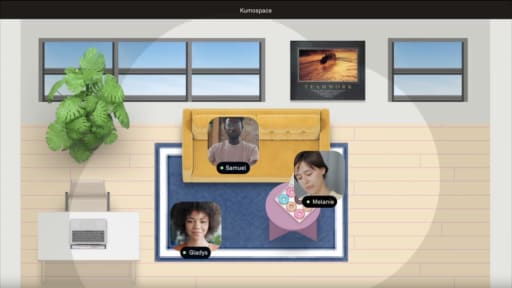
Kumospace is a virtual office platform for remote and hybrid teams. For a team trying to fix the pattern in the diagnostic table above, the part that matters most is visibility: its persistent virtual office stays open so people can see who's actually around instead of guessing from a status dot. That visibility creates space for spontaneous conversations and informal collaboration that structured calendars otherwise eliminate; spatial audio lets people drift into a quick conversation the way they would walking past someone's desk, without anyone having to book a call for it.
What to Do This Week
A remote culture health check works because small, consistent changes to communication, documentation, and decision practices compound faster than a big culture campaign. They change what people do this week rather than what they're told the culture is. Start with a one-week audit of your calendars, channels, and decision records, matching each observation to its likely cause before you change anything. Then pick one process, like a single recurring meeting, and redesign it for async work and transparent decisions.
Remote teams recover fastest when leaders change their own habits first and ask for feedback on what's working, rather than announcing a finished culture plan from the top. Measuring remote team culture doesn't require a new survey or a new tool. Every red flag worth acting on is already visible in data you hold, which usually means the fix is smaller than it looks from the outside.
Frequently Asked Questions
You'll usually notice meeting and documentation changes within a few weeks, because the friction they remove is immediate. Shifts in promotion criteria or psychological safety take one or two review cycles before you can read them clearly. Pick a few concrete indicators, such as help-seeking in public channels or fewer last-minute "urgent" meetings, and track them over at least a month. Set a baseline before you change anything, so you can tell a real shift from a quiet week.
Yes. Being transparent usually works better: let people know you are examining how remote work is functioning so you can improve systems, not to single anyone out. Invite specific feedback on team meetings, digital tools, and communication styles, and close the loop publicly on at least one change you make based on what you hear. Telling people you are working to protect that flexibility builds trust faster than silent observation does.
Start with neutral, observable data: calendar load, response patterns, or onboarding feedback rather than opinions about culture. Share one or two low-risk experiments, like converting a single recurring meeting to a written update, rather than proposing a full overhaul. Leaders are more likely to engage when they see clear friction in the current setup and a simple proposal to test it.
Yes, and many strong remote cultures operate a hybrid model, as long as remote employees are treated as the default rather than the exception. Decisions, written communication, and meetings need to work without anyone being physically present, and any in-office advantages, like quick hallway decisions, need to be documented and shared so distributed teammates aren't second-class citizens. Global Workplace Analytics estimates a typical U.S. employer saves about $11,000 a year for each employee who works remotely half the time, from higher productivity, lower real estate costs, and reduced absenteeism and turnover. The model predates the pandemic, but those savings evaporate if keeping the office recreates the proximity bias you were trying to eliminate.
If multiple people in similar roles struggle in the same way, especially across locations, it's likely a system or culture issue. If the pattern is unique to one person who has clear expectations, support, and a reasonable schedule, individual performance may be the main factor. Check whether the right tools, clarity, and psychological safety are in place before concluding an individual is the problem, since what looks like low motivation in one person is often a shared pattern affecting everyone who lacks a clear path forward.