Proximity bias in remote work occurs when managers favor in-office employees over remote team members, showing that remote work does not eliminate workplace bias. In hybrid teams, employees who are physically present can become more visible, giving them an advantage in recognition, decisions, promotions, and high-profile projects.
The distinction that matters is between an incident and a pattern. A single overlooked remote employee proves nothing. The same skew repeating across promotions, assignments, and meeting airtime over two or three quarters is a structural problem you can fix.
Key Takeaways
- Proximity bias can quietly affect promotions, recognition, stretch assignments, and decision-making when in-office employees have more visibility than remote coworkers.
- Managers can reduce it by making meetings, decisions, recognition, and career opportunities more structured, documented, and accessible to everyone regardless of location.
- Track patterns in promotions, project assignments, and participation to identify bias early, then focus evaluations on measurable contributions rather than physical presence.
What proximity bias in remote teams actually is (and isn't)

Proximity bias favors in-person workers over remote employees by making physically present contributions feel larger, more reliable, and more memorable. In a hybrid or remote work environment, favoring in-office employees can occur without anyone intending it. A manager who sees a colleague solve a problem at the whiteboard will recall that moment during a performance evaluation process far more vividly than a remote worker's equally important fix documented in a ticket.
This is different from general favoritism, which is rooted in personal liking. You might favor someone in a different country simply because you enjoy their personality. Similarity bias, meanwhile, is about favoring people who share your background, gender, or culture, regardless of where they sit. Time-zone bias is a scheduling problem: some people are asleep when decisions happen, but that can exist without anyone showing preferential treatment to those who happen to be awake.
Two things that look like proximity bias but are not: assigning a crisis task to whoever is literally online at 2 a.m. is not proximity bias. Neither is giving a client-facing role to the person whose job description requires it. These become proximity bias only when the pattern repeats over months, consistently channeling interesting projects and career-making visibility to onsite workers while remote team members handle maintenance work.
Concrete signs your remote team is suffering from proximity bias
The signs below are patterns, not incidents. One instance of any of them proves nothing. Spend a week reviewing calendars, meeting notes, and project boards. You are looking for repeated, directional skew in who gets opportunities, airtime, and information, not for a single unlucky scheduling conflict.
Sign 1: Remote employees are overlooked for promotion and high-visibility projects
Over the last 6 to 12 months, check whether promotions, raises, or stretch assignments favored employees who spent more time in the office. An analysis of two million white-collar workers by Live Data Technologies found that 3.9% of fully remote employees were promoted in 2023, against 5.6% of those working in an office full time or on a hybrid basis, a gap of 31%. The penalty appears specific to fully remote work. A 2024 Stanford study published in Nature found hybrid employees working two days from home were promoted at the same rate as fully in-office peers, so the risk concentrates on people who are rarely or never in the building.
Sign 2: Key decisions are made in the room, then announced to remote employees
Hybrid meetings end, remote attendees drop off, and the in-person group keeps talking, making the real decision at the whiteboard or over lunch. Remote employees often miss impromptu discussions this way, leaving them excluded from critical context and decision-making. You will spot this in calendars: remote workers see events titled "Update" or "Announcement" but are rarely on the original decision-making invite.
This creates a self-reinforcing loop. In-person employees gain more context, appear more strategic, and get chosen for the next round of decisions. In rare cases, the pattern is driven by time pressure or confidentiality, but look for repeated exclusion across everyday topics, not just one sensitive project.
Sign 3: Remote employees speak less in hybrid meetings and get interrupted more
Across several weekly standups or planning calls, people in the room speak spontaneously while remote attendees only speak when called on or are talked over when their audio lags. Meeting facilitators naturally read the body language of those physically present, turning toward them and inviting input, which becomes structural proximity bias over time.
An alternative explanation: certain employees may be newer or more introverted. Compare their participation in fully virtual meetings to see if the pattern persists. Check recordings or notes rather than personal impressions when judging how often each person contributes.
Sign 4: Stretch work and career-making tasks go to whoever is easiest to grab
When you need someone for a last-minute client call, you ask the desk neighbor instead of pinging the remote subject-matter expert. Remote employees may miss out on spontaneous opportunities for recognition this way. Over a quarter, in-person employees build portfolios full of launches and executive presentations that later justify their promotions, while fully remote workers stay on routine tasks.
Sign 5: Remote workers report feeling invisible or stuck despite hitting goals
Engagement or pulse survey comments from remote staff mention being "left out," "last to know," or "stuck" with maintenance work. The comments cluster around a ceiling: people who are hitting their targets but cannot see a path past their current role.
If similar comments cluster in one manager's team rather than across the organization, that points to a localized leadership problem rather than organization-wide proximity bias. Cross-check subjective feedback with objective data on recognition and advancement.
Why proximity bias happens in remote and hybrid workplaces

Proximity bias is a structural side effect of how information flows in hybrid working arrangements, not a personal moral failing. But the mechanisms run through decisions you make daily, which means you have more leverage than you might think. A 2021 SHRM survey of 817 supervisors found 67% considered remote workers more easily replaceable than onsite workers and 72% would prefer all their subordinates in the office. The survey predates the normalization of hybrid work, so treat it as a floor rather than a current reading. These survey results illustrate how strongly stated managerial preferences continue to favor physical office presence.
Causes you directly control. You rely on direct observation and informal signals when recalling contributions. The colleague you saw solving a problem yesterday is more available in memory than the one who solved a harder problem asynchronously last week. You run meetings where in-room body language drives turn-taking. You hand out stretch work by asking whoever is physically closer instead of checking the project board. The antiquated assumption that office presence equals commitment still shapes how many managers evaluate reliability.
Causes you partly influence. Promotion criteria are often vague enough that visibility and presence sway the decision-making process more than measured outcomes. Informal recognition channels, such as hallway conversations and coffee-line praise, naturally benefit office-based employees. Coaching managers to recognize biases in formal performance reviews requires leadership training and organizational will, but you can advocate for it.
Environmental constraints. Time zones create real synchronization problems. Company headquarters naturally pulls communication, leadership focus, and informal decision-making toward in-office staff. Distributed team proximity bias looks different from office-heavy hybrid bias: in a fully distributed team, the issue is less about who sits near the boss and more about who shares the boss's working hours or communication style, creating subtler but real imbalances across the remote team.
Diagnostic table: Linking proximity bias signs to root causes and first steps
|
Observable sign |
Likely underlying cause |
First intervention |
|
Onsite employees promoted at higher rates despite comparable performance data |
Manager recall favors contributions seen in person |
Review last two promotion rounds by work location and compare against documented performance ratings |
|
Decisions finalized after hybrid calls end with only in-room staff |
No norm requiring written decision records |
Require any post-call decision to be shared in a channel for 24-hour comment before it is final |
|
Remote attendees speak only when called on; in-room staff speak freely |
Facilitator reads in-room body language by default |
Rotate facilitators and ask remote participants to speak first on each agenda item |
|
Stretch assignments consistently go to whoever sits nearest the manager |
Manager defaults to proximity when assigning tasks |
Log every stretch assignment for one quarter, noting who was considered and why |
|
Remote employees report feeling invisible in engagement surveys |
Recognition happens informally in hallways |
Move recognition to a shared channel where all contributions are posted weekly |
|
Career development conversations happen only with onsite employees |
Unscheduled desk drop-ins replace structured check-ins |
Set a fixed cadence of 1:1s for every team member with a shared agenda |
|
Same remote workers repeatedly excluded from cross-functional meetings |
Invite lists built from memory of recent in-person interactions |
Build invite lists from the project RACI, not from who comes to mind first |
|
Performance reviews rate in-person employees higher on "collaboration" |
Collaboration measured by visibility rather than output |
Replace subjective collaboration ratings with documented contributions to shared deliverables |
What to do about proximity bias in remote work
The first two fixes cost nothing and need no one's approval. The later ones need access to promotion records or working meeting room equipment. Start with the first recommendation on this list regardless of what permissions or resources you currently have.
Start by making your own decisions and meetings remote-first
Redesign recurring team meetings so remote attendees speak early, have clear turns, and can contribute in chat or shared docs. Promote remote-first meeting norms by declaring that any decision made after the call ends and remote people drop must be written and shared for comment before it is final. For the next month, keep a simple log of who you give big tasks to and why, then review it weekly to spot whether you are leaning toward people you see. This step depends on you having at least minimal control over your own calendar. If not, start with your immediate team rituals anyway.
Shift visibility from being in person to being in the work
Document-first cultures ensure information is accessible regardless of physical location. Move status updates, design reviews, and decision records into written or recorded artifacts. Use asynchronous tools to balance visibility among employees: a shared project board where contributions are visible by task, not by who is in the office. Route approvals through a shared channel rather than through whoever reaches your desk first. Documenting remote employees' contributions and responding promptly helps lessen their pressure to overwork to prove physical presence.
Standardize criteria for promotions, raises, and plum assignments
Define clear criteria for advancement to ensure fairness: outcomes, scope, and behaviors, applied consistently regardless of work location. Evaluations should focus on deliverables instead of physical presence. With HR, review the last one to two years of promotions and significant project assignments by location, and check whether outcomes align with your stated criteria. Use a longer window here than the 6 to 12 months you would use to spot a pattern, since a formal audit needs more than one review cycle. Involve peers or a calibration panel so the decision-making process is not based solely on one manager's memory. If patterns differ systematically by work location or employee group, they are worth reviewing with HR or counsel.
Redesign hybrid rituals so remote people are not second-class participants
Set up hybrid meetings where everyone joins from their own device, even if some are in the office, leveling audio and video presence. Rotate facilitators between in-person and remote employees and explicitly track who has spoken. If meeting room equipment is lacking, make key meetings fully virtual until basics can be fixed. Some organizations use persistent virtual offices to keep ad-hoc interactions visible and foster spontaneous collaboration across distributed teams.
Common responses to proximity bias that usually backfire

Some intuitive fixes intensify the problem by punishing flexibility and measuring visibility instead of outcomes. Each of these responses makes the underlying problem harder to see by measuring presence more precisely instead of measuring less.
Mandatory camera policies. Requiring cameras on for every video call does not create equal access to decisions. It creates surveillance theater that erodes trust, especially for remote workers balancing caregiving responsibilities or seeking improved work-life balance.
Activity tracking and screenshot software. Status-light policing and keystroke monitoring measure presence, not output. They damage the professional relationships and psychological safety that remote and hybrid work depends on. Never use these as diagnostic tools.
Mandated office attendance. Requiring everyone back to the office space removes flexible work arrangements without fixing biased processes. It removes flexibility from the people who value it most. Future Forum survey data found Black knowledge workers in the US reported a stronger preference for flexible work than their white counterparts, and caregivers show a similar pattern.
Symbolic inclusion efforts. A one-off town hall on inclusion without follow-through on promotion or assignment data undermines credibility. It signals awareness without changing the playing field, and many employees will see through it.
Rewarding office presence directly. Offering perks only to onsite employees, like networking events or in-person-only development opportunities, formalizes the bias rather than addressing it.
When proximity bias is not the main problem
Similar patterns, such as one group getting more raises or airtime, can come from other issues. Compensation band design, a single underperforming manager, or real performance gaps can all produce skewed outcomes. You can distinguish pay-design problems from proximity bias by checking whether discrepancies remain after controlling for level, tenure, and documented results. Sustained conflict between individuals, unclear roles, or workload imbalances can also make certain employees appear sidelined regardless of remote or in-person status. Personal or medical issues in an employee's life can affect visibility or participation; your role is to adjust the working conditions you control and point people toward appropriate support, not to diagnose anyone.
Using virtual collaboration to reduce proximity bias
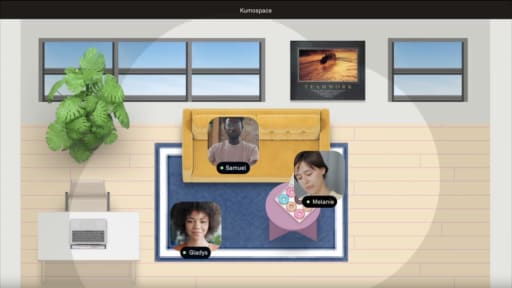
Hybrid teams can unintentionally give in-office employees more visibility through hallway conversations, spontaneous problem-solving, and informal decision-making. When remote employees miss those interactions, they can lose access to the same context and opportunities even when their work is equally strong. A virtual office platform like Kumospace can help create a more consistent environment for remote and hybrid collaboration. Features such as persistent virtual spaces, spatial audio, and informal meeting areas give distributed employees opportunities to connect without relying entirely on scheduled meetings.
For hybrid teams concerned about proximity bias, the goal is to make informal collaboration and visibility accessible to all team members, regardless of where they work. This can be particularly useful for distributed teams that want to strengthen connection while keeping decisions, recognition, and career opportunities based on contribution rather than physical presence.
Summary
Proximity bias can give in-office employees an advantage in visibility, recognition, promotions, and high-profile opportunities, even when remote employees perform equally well. A single overlooked employee proves nothing; the same skew across three promotion rounds and a quarter of assignment logs is a pattern you can act on. The causes sit in process rather than in intent. Decisions made after the hybrid call ends, recognition that happens in hallways, and promotion criteria loose enough for visibility to fill the gaps will produce the same outcome no matter how fair-minded the manager is.
The practical fixes focus on remote-first meetings, documented decisions, outcome-based performance evaluations, structured promotion criteria, and equal access to collaboration and career opportunities. Tracking promotions, stretch assignments, participation, and employee feedback can help teams identify patterns early. Kumospace and similar virtual office platforms give distributed teams a place where informal conversation is visible to everyone, which helps once those process changes are in place, helping hybrid teams reduce visibility gaps without requiring everyone to work in the same physical space.
Frequently Asked Questions
Small changes in meetings and assignment logs can shift who speaks and who gets opportunities within a few weeks, but visible changes in promotion patterns and employee satisfaction scores usually take at least one to two review cycles. Pick one or two key metrics, such as distribution of stretch assignments by location, and track them quarterly.
Being transparent usually helps. Name specific behaviors you are changing, such as "we will no longer make final decisions after hybrid calls end," rather than accusing anyone of bias. Invite examples from both remote and in-person employees about times they felt excluded and use those stories to adjust processes together, keeping everyone on the same page.
Bring simple, concrete evidence: a list of recent promotions or project leads by location alongside performance data, and ask open questions like "What do you see in this pattern?" Frame the issue as a risk to talent retention, not an attack on any individual leader. Point to your own numbers first. External coverage helps frame the conversation, but a list of promotions by work location alongside performance ratings is harder to argue with than an article.
Proximity bias is a risk in any hybrid workplace but not a foregone conclusion. Organizations using remote-first norms, outcome-based evaluation, and inclusive meeting practices close the specific gaps where presence substitutes for evidence. Companies that regularly review decisions by work location and adjust their company culture can sustain hybrid models without systematically sidelining remote employees.
Compare the remote employee's documented outcomes, deadlines, and feedback to peers at the same level, and check whether expectations were clearly set and supported. If performance is clearly lower despite fair goals and support, address it through normal performance management. But if multiple remote workers show the same pattern of being overlooked while hitting targets, the system, not the individuals, is likely the problem.