Founders lose touch with remote teams as the company scales, once most of what they know starts arriving through one or two layers of managers instead of from the work itself. It's a structural consequence of adding layers, not a personal failing, which is why it happens quietly enough that nobody flags it.
A founder can still describe last quarter's OKRs in detail and be unable to name what any individual contributor two levels down shipped in the last two weeks. Knowing the numbers but not the work behind them is usually the first sign, and it surfaces as a resignation or a missed launch.
Key Takeaways
- You typically start losing touch once most of what you know arrives through one or two layers of managers, rather than at any particular headcount.
- The clearest early indicator is being able to recite the metrics but not name what a team two levels down actually shipped in the last two weeks.
- The fix that works is redesigning your own communication routines so they bypass hierarchy regularly; the fix that backfires is adding more status meetings or surveillance tools, which increase noise and distrust instead of restoring real visibility.
How do you know you're losing touch with a scaling remote team?

You can usually confirm this within a week by paying attention to how you already spend time and how information reaches you. Watch for the patterns below.
You mostly hear about remote teams through your direct reports
By the time two layers sit between you and most individual contributors, almost everything you know about how the work is going reaches you through a weekly leadership call, forwarded Slack summaries, or dashboards, not through watching the work happen. That reflects the management pattern Paul Graham criticizes in his 2024 essay "Founder Mode," where he argues against the principle that a CEO should engage with the company only through direct reports. The trigger isn't a headcount number, it's how many layers sit between you and the work.
Healthy delegation is a benign explanation once you've added a management layer. But if you can't recall an unprompted conversation with someone two levels down in the last month, distance has already set in.
You can quote metrics but not describe the work behind them
You can recite weekly active users, MRR, enrollment, or renewal rate, whichever number your organization runs on, but struggle to explain which remote team shipped what in the last two weeks that moved it. Dashboards overtake narrative context and make progress look smoother than it feels to the remote workers actually doing it.
If this is temporary because you're in a fundraising sprint, that's fine. If it lasts more than one quarter, you're likely disconnected from how the work actually gets done.
Some remote teams feel "blurry" when you picture them
Mentally list each distributed team and notice where you can't quickly name two or three people or current priorities. Consider a company with engineering split across Manila and Kraków, product in Berlin, and a support org running three shifts out of Austin and Dublin.Or a services company with account managers in two regional offices and an implementation team split between a hub and three client sites. In both cases the test is identical: can you name people, priorities, and constraints? In both cases the group that's been around longest is usually the one that's gone blurriest.
This blurriness means certain remote employees are invisible to you except during escalations. Newly formed teams in their first month will naturally feel vague. But if a long-standing remote group remains hard to picture in terms of people, priorities, and constraints, treat that as a visibility gap worth investigating.
Your calendar shows almost no time with ICs outside crises
Your week fills up with exec one-on-ones, investor calls, and cross-functional leadership meetings, and individual contributors only join for escalations. That's normal once you've built out a full exec layer, but it's more dangerous for remote teams, where you can't walk the floor to compensate for it.
If you're in a major launch window, the pattern is temporary. If it persists for more than six to eight weeks, you're losing touch with real remote team sentiment and constraints, and problems that would otherwise surface in a hallway conversation start surfacing as missed deadlines instead.
Surprises appear first in Slack threads, not in your meetings
You discover a missed deadline, a departing senior engineer, or a customer escalation in a public channel rather than in your leadership sync. Remote workers escalate sideways through communication platforms because upward channels feel slow or opaque. Time-zone delays are an innocent explanation. But repeated "I'm hearing about this too late" moments over a month confirm a visibility problem across your distributed teams.
Remote employees quote decisions you don't remember making
A remote team member references "the founder said in May that we won't support on-prem," but you recall a tentative comment, not a firm decision. At scale, offhand remarks in webinars or AMAs turn into de facto policy once they're not documented and clarified, and your words now travel further and faster than your corrections can catch up.
This points to a gap in documentation and follow-up habits, not in your intent. Without a habit of writing decisions down in one place, unclear ownership spreads and ambiguous statements calcify into rules nobody actually decided on.
Why founders lose touch with distributed teams as the company grows

Most of it comes from the same place: the culture you can see is now the culture your managers describe to you, and that gap widens with every layer you add. There is no universal headcount threshold; the more useful signal is when management layers begin separating the founder from day-to-day work.
Information funnels through management layers. Each layer introduces filtering and delay. Gallup's span-of-control research found the average number of direct reports per U.S. manager rose from 10.9 in 2024 to 12.1 in 2025, while the median held at five to six, so the jump reflects a growing share of managers carrying very large teams rather than a shift for the typical manager. That strains what any one manager can accurately relay upward. You partly influence this; you can change it fully only by redesigning structure.
Meeting design and communication rhythms ignore remote realities. When meetings assume synchronous overlap and agendas stay loose, nuance gets lost in the compression. Establishing clear communication norms, such as where specific conversations happen and how decisions get documented, helps counter this.
Time zone spread erodes informal contact. Core collaboration hours help as teams span a couple of time zones, but the useful overlap shrinks fast once a team spans three or more. You partly control this through hiring decisions and scheduling.
Documentation and tooling gaps. Without a centralized source of truth, information silos form and every update has to travel by word of mouth. You fully control your own documentation habits.
Psychological safety declines. When team members believe only polished messages reach leadership, they self-censor before anything reaches you. You set the tone here; structural effort is what makes it stick.
Remote team visibility at scale: signs and first fixes
|
Observable sign |
Likely underlying cause |
First intervention |
|
You learn about deadlines missed by a remote team via Slack, not your sync |
Upward channels feel slow or opaque |
Add a standing agenda item in leadership syncs for "what nearly broke this week" |
|
You can name metrics but not what shipped behind them |
Dashboard dependency without narrative context |
Join one IC-level team review monthly, rotating across teams |
|
A remote group feels blurry when you picture them |
No regular founder-to-IC contact with that group |
Schedule a 30-minute rotating Q&A with that team within two weeks |
|
Your calendar has zero IC time outside escalations |
Meeting structure built for executives only |
Block 10 to 20% of your week for non-report interactions |
|
Remote employees reference decisions you never finalized |
Verbal decisions undocumented and reinterpreted |
Publish a weekly written note covering what changed and why |
|
Most updates about a remote team reach you through one manager |
Onboarding not adapted for remote environments |
Assign a mentor and schedule frequent one-on-one check-ins during onboarding |
|
Vague goals lead to stalled execution and fading accountability |
Objectives not visible or defined at team level |
Make shared objectives visible in a single doc, set clear SLAs for response times |
|
Response times vary wildly across time zones |
No agreed communication norms or core hours |
Define core overlap hours and set clear expectations for async response windows |
Pick one or two rows that match what you're seeing right now and commit to addressing them over the next two weeks. Trying to fix everything simultaneously creates noise.
What to do when you feel disconnected from your remote team
The first moves should change how you personally communicate and collect information. Before buying project management tools or restructuring the org chart, adjust what you actually control: your calendar, your communication habits, and how decisions reach the people doing the work.
Reshape your own information diet before changing anyone else's
Commit at least 10 to 20% of your work week to interacting with remote team members who don't report directly to you, through group Q&As, short "office hours," or rotating team reviews. Replace status-heavy one-on-ones with agenda-light conversations focused on what feels hard. Regular one-on-ones maintain interpersonal connections as teams grow, and this applies equally to skip-level touchpoints.
This works if you consistently protect the time for at least four to six weeks and avoid turning the sessions into performance reviews. Record them so people in other time zones can catch up on their own schedule. If nothing changes after that window, escalate to restructuring team boundaries instead of adding more sessions.
Make your decisions and reasoning visible in writing
Publish a short weekly founder note in a shared doc or your main Slack channel covering three things: what changed, why, and what won't change yet. For distributed teams, written context is what keeps a passing remark from turning into a rumor that outruns your ability to correct it.
This takes discipline to keep concise and to link to the relevant docs rather than restate them. If weekly proves unsustainable, switch to biweekly, but stay regular either way.
Rebuild your meeting cadence around remote-first alignment
Reshape recurring meetings so they actually serve remote work: pre-reads distributed in advance, short live discussion, decisions documented during the call rather than after. Recording the important ones lets people catch up asynchronously, and a regular audit of what's on the calendar usually turns up at least one recurring call that's become a status update nobody needs anymore.
Join at least one functional review a month that includes ICs, not just managers, rotating across time zones so it's not always the same group's morning. Use live video for the calls where a decision actually gets made, and let updates stay async, since that's usually where the two modes are being used backwards. If a meeting keeps devolving into a status update anyway, coach whoever's running it or replace the format entirely.
Create lightweight, recurring "windows" into distributed teams
Rituals like a monthly live demo, a rotating show-and-tell, or a "day in the life" session led by a different remote team member each time, kept to 30 to 45 minutes, rebuild your sense of what a team can actually do and what's in their way faster than a polished deck ever will. Someone walking you through a live ticket queue, a half-finished project, or something they're genuinely stuck on tells you more than a status slide can.
A regular all-hands helps at a smaller size, but past a few hundred people across several time zones, one company-wide call stops being a real window into anything and becomes a broadcast. A shared space people can drop into casually helps recreate some of that informal, in-between contact one big call can't; the ritual matters more than the specific tool, but the space still needs to exist somewhere.
Adjust structure once patterns are clear, not before
Only after one to two months of better visibility should you consider structural changes: clarifying manager spans, redefining team boundaries, or appointing site leads for large time-zone clusters. Strategy& documented Fortune 100 client that realized roughly USD 200 million in cost savings by redesigning spans and layers over 12 weeks. These changes work best when grounded in specific observations about where communication or accountability keeps breaking, not in abstract org-chart ideals. Involve one or two respected remote team members in drafting any structural change, since structure that fits how work actually flows holds up better than structure that just looks clean on paper.
What usually backfires when trying to reconnect with remote teams

When you feel out of touch, the instinct is to add tools, mandates, or meetings. Several of the most common moves predictably make things worse.
Adding more status meetings. This creates noise. At worst, it pushes energy into appearing "on track" rather than doing hard work. Most leaders add meetings reflexively, but this masks the underlying visibility loss rather than solving it.
Buying surveillance software. Keystroke logging, screenshot capture, and strict camera-on rules measure activity, not output, and erode the psychological safety these problems depend on. Idle time tracking treats presence as performance and drives the best talent to companies that don't monitor them.
Mandating office attendance without fixing remote visibility first. A study of Ericsson's Swedish workforce by Šmite, Zieris and Damm found engineers onboarded fully remotely were significantly more likely to resign between six months and three years in, with retention returning to pre-pandemic levels only after structured hybrid policies took hold. The authors recommend pairing in-office presence for new hires with presence from their teammates and mentors, on the grounds that fully remote onboarding weakens organizational attachment. The fix there was structural and specific to onboarding, not a blanket return-to-office mandate, and dragging an entire team back to the office doesn't repair the information architecture that actually broke.
Re-centralizing every decision through the founder. This creates a bottleneck, overburdens you, and undermines the delegation that sustainable growth actually requires. It signals distrust without building any real connection.
When losing touch is not the core problem
If complaints or departures cluster around pay or equity differences between remote and in-office employees, that's a compensation structure issue, not visibility. If issues are localized under a specific manager, the pattern is about that manager, not your operating cadence. Vague goals lead to stalled execution, but if targets are met with steady output that's simply slow, you may have a capacity or capability problem that needs targeted support, not more founder attention.
Sometimes an individual's personal circumstances reduce their visibility. A manager's role is to adjust the working conditions they control and point people toward proper support, not to diagnose them. If visibility issues intersect with pay, promotion, or termination patterns that differ systematically by work location, involve HR or legal counsel. Performance reviews should be audited for consistency across remote and in-office employees, and new team members working remotely deserve the same onboarding rigor as anyone on site.
Where a shared virtual space fits into rebuilding visibility
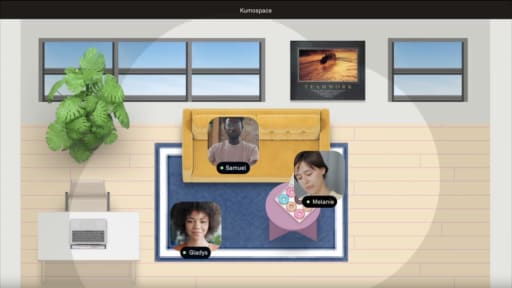
Several of the fixes above depend on informal, low-stakes contact, the kind that used to happen by walking past someone's desk, that's hard to manufacture through scheduled meetings alone. Rituals like a monthly demo or a rotating show-and-tell help, but they're still appointments; what's missing in between is a place where that contact can happen without anyone having to schedule it. Kumospace is a virtual office platform for remote and hybrid teams built for exactly that gap.
Its persistent virtual office gives distributed teams a shared space to be visibly present during the day, so a founder or a teammate can drop in on a conversation the way they'd stop by a desk, instead of needing a calendar invite to justify the interruption. Its spatial audio makes that presence feel closer to actually sharing a room. Ambient, unscheduled contact of that kind is what a founder loses first as layers and time zones stack up.
It doesn't replace the habits above: the written notes, the skip-level Q&As, the IC-level reviews. It just gives them a physical-feeling place to happen in between, and it fits best for teams that already have those structural habits in place and want to close the remaining gap.
Losing touch with a remote team as the company scales: where to start
Losing touch with a remote team as the company expands is a structural consequence of growth, and it responds to deliberate changes in how you gather and share information rather than to a reorg. The test is specific: if you can recite the metrics but can't name what a team two levels down shipped in the last two weeks, the gap is already open.
Schedule one recurring open Q&A with a rotating remote team this week, and commit to a brief written update for the next six weeks. That combination gives you direct signal and gives your team consistent communication from the top, which is the foundation everything else builds on.
Frequently asked questions
Consistently changing your calendar and communication routines creates more direct opportunities to hear from the team; how quickly that improves your sense of connection will vary by organization. Revisit these routines as the team grows so new management layers, time zones, or communication habits do not recreate the same visibility gap.
Naming the pattern in simple terms during an all-hands or written note can build trust, as long as you also explain the concrete steps you're taking to change how you listen and communicate. Frame it as a problem in how information moves, not as a failure by the team or its managers.
It's common for founders to feel less connected once they add a management layer, especially in remote teams, but treating this drift as a permanent fact rather than a design problem is what causes lasting damage. Treating it as a design problem means deciding at each growth stage which channels reach you directly, then protecting those channels when the calendar fills.
Frame the conversation around structural limits of information flow in distributed teams, making it clear the goal is to add more direct channels, not to bypass or second-guess managers' judgment. Emphasize that the new channels report into the whole leadership team, so your managers see the same signal you do.
If you see inconsistent goals, unclear ownership, or frequent surprises from that group, it points to alignment and visibility issues. A clear plan with steady but low output may point to a capacity or capability problem that needs targeted support rather than more founder oversight. The three pillars to check are whether employees understand the objectives, whether they have the right tools, and whether they can solve problems without waiting on you.