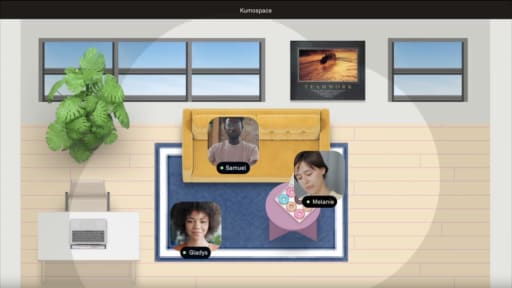
Whether you’re at a crowded tech conference, introducing yourself in a Kumospace virtual office, or replying to a LinkedIn message from a potential employer, you have about 30 seconds to make a strong first impression. That’s where an elevator statement comes in, a brief, persuasive way to capture attention before your listener moves on.
The terms elevator statement, elevator pitch, and elevator speech are often used interchangeably. This article uses “elevator statement” to emphasize clarity over a hard sell. A strong elevator pitch helps you stand out in crowded markets and remote or hybrid work settings where attention is limited.
What Is an Elevator Statement?
An elevator statement is a brief, persuasive summary of who you are, what you do, and why it matters, delivered in about 20 to 45 seconds. The goal isn’t to close a deal on the spot. It’s to spark interest and open a conversation that continues beyond those first moments.
Where do elevator statements show up in real life?
- A 2026 tech industry summit in Austin where you have 30 seconds between sessions
- A quick intro in a Kumospace virtual office during a team town hall
- An impromptu chat after a webinar when someone asks what you do
There are three main types:
- Personal elevator statement: For career goals and professional networking events
- Product/service statement: For sales conversations and fundraising
- Company statement: For brand positioning and partnerships
Unlike a full presentation or cover letters, an elevator statement is designed for speed. You’re not sharing your entire professional experience, you’re giving just enough to earn follow up questions.
How Long Should an Elevator Statement Be?
The practical range is 20 to 30 seconds (40 to 75 words) for most networking events, and up to 45 to 60 seconds for a job interview or investor intro where time is reserved.
Modern research on attention span, especially since social platforms trained users to process information quickly, means your opening line needs to be tight. Save the details for the conversation that follows.
Timing rules of thumb:
- 20 seconds: Quick intros at a career fair, conference hallway, or virtual breakout room
- 30 seconds: First-time meetings and networking events
- 45–60 seconds: When someone explicitly asks “Tell me about yourself” in an interview
Aim for roughly 50 words, then trim. Test by reading aloud with a timer. If it feels rushed, cut more.
The 3 C’s of a Great Elevator Statement

Every strong elevator pitch passes through a simple checklist: clear, concise, and compelling. Keep these in mind during virtual team meetings.
- Clear: Use plain language and focus on one main message. Replace buzzwords like “synergistic solutions” with concrete phrases like “we help distributed teams run smoother meetings.” Your target audience should understand what you do in one pass.
- Concise: Eliminate side stories and credentials that don’t directly support your goal. Trim every sentence to contain one idea. If you’re rambling about your bachelor’s degree when pitching a business idea, you’ve lost focus.
- Compelling: Focus on outcomes such as saved time, increased revenue, stronger culture. Include a hint of data or a short personal story that invites follow up questions. The person listening should want to know more.
How to Write an Elevator Statement
Most people struggle to write an elevator pitch not because they lack achievements, but because they try to say too much at once. The solution is a simple, repeatable structure that works whether you’re a remote marketing manager or a startup founder raising a seed round.
Step 1: Start With a Crisp Introduction
Open with your name, role, and focus in one sentence. This establishes your personal brand immediately.
Example: “I’m Alex Chen, a product marketer who helps B2B SaaS teams turn complex features into clear stories.”
Tailor the tone based on context:
- Interviews: “I’m Alex Chen, currently a product marketing lead at…”
- Networking events: “Hi, I’m Alex, I work in product marketing for SaaS companies.”
- Virtual spaces like Kumospace: “I host our weekly product demo sessions in Kumospace, so you might’ve seen me around.”
Avoid long histories. Keep it to your current role and core area of impact. Add one small, specific detail if it sets up your pitch, like “remote-first teams” or “enterprise security.”
Step 2: Name the Problem or Opportunity
State a concrete problem with a real-world feel. This is where you convey value by showing you understand what matters.
Examples:
- “Most remote teams waste hours each week setting up meetings that still feel chaotic.”
- “Fast-growing startups struggle to hire experienced finance leaders before Series A.”
- “Small businesses often lack the internal skills to compete with larger company marketing budgets.”
Use data points from the last few years to make the issue credible. Keep this to one short sentence so the listener quickly understands your focus.
Step 3: Present Your Solution in One Sentence
Connect your work directly to the problem using action-oriented verbs: design, build, streamline, launch. Avoid generic verbs like “do” or “handle.”
Personal example: “I design onboarding programs that cut ramp-up time for new engineers by about 30 days.”
Product example: “We help distributed teams host immersive virtual offices in Kumospace so teammates feel like they’re in the same room.”
Include one specific result when possible, such as a percentage, hours saved per week, or revenue impact. This makes your claim easier to evaluate.
Step 4: Add a Simple Value Proposition or Differentiator
Answer “Why you?” in one short phrase. This is your unique selling proposition.
Three angles for differentiation:
- Depth of experience: “10 years in e-commerce logistics across three continents”
- Unique methodology: “Data-backed playbooks tested across 50+ remote teams”
- Distinctive platform: “An always-on virtual HQ in Kumospace instead of static chat threads”
Avoid vague claims like “best” or “world-class.” Replace them with concrete comparisons or a clear niche focus that listeners can recognize. A strong elevator pitch makes your value specific enough to remember.
Step 5: Close With a Light, Clear Call to Action
End with an easy next step, not a hard sell. The main goal of your elevator statement is to invite the next conversation.
Context-specific CTAs:
- Networking: “Would you be open to connecting on LinkedIn after the event?”
- Interviews: “I’d love to discuss how my experience aligns with what you’re building.”
- Sales: “Could I send you a one-pager after this session?”
- Virtual events: “Can I drop a quick overview link in the Kumospace chat?”
Match the ask to time and context. Smaller asks for busy executives, and more open-ended invites for peers.
Plug-and-Play Elevator Statement Templates
These templates are starting points. Rewrite in your own voice, test out loud, and iterate. Each template specifies the ideal context.
General Elevator Statement Template
Formula: “Hi, I’m [name], a [role] who helps [type of person/company] solve [specific problem]. Recently, I [credible result]. I’d love to [CTA tied to context].”
Instructions:
- Be specific about “type of person/company”
- Choose one problem
- Use a real result from the last 2–3 years
- Pick a low-friction CTA
Full example: “Hi, I’m Jordan Lee, a growth marketing lead who helps early-stage SaaS teams acquire their first 1,000 customers. Last quarter, I ran a campaign that grew signups by 40% in 60 days. I’d love to hear what growth challenges you’re tackling.”
This template can be trimmed to 1–2 sentences for very fast introductions.
Job Seeker / Career Changer Template
Formula: “I’m [name], a [current or most recent role] with [X] years in [field]. I specialize in [skill set], and in my last role at [company] I [quantified result]. I’m currently looking for [type of role] where I can [specific way you’ll add value].”
For students and recent graduates: swap years of experience for degrees, projects, internships, or certifications. Mention your computer science degree or capstone project with tangible outcomes.
Career-change example: “I’m Maria Santos, a finance analyst with five years in corporate FP&A. I completed a data analytics bootcamp in 2023 and built three portfolio projects using real retail datasets. I’m looking for an analyst role where I can combine financial expertise with predictive modeling.”
End with a CTA aligned with job search, such as asking about open roles, referrals, or feedback on fit.
Founder / Entrepreneur Template
Formula: “I’m [name], founder of [company name], a [brief category] that helps [target customers] solve [pain point]. We do this by [solution in plain English], which has helped customers [specific metric]. We’re currently [raising, expanding, or looking for] [specific ask].”
Example: “I’m David Park, founder of FlowSync, project management software that helps remote agencies eliminate status meetings. We provide real-time progress dashboards that cut weekly sync time by 3 hours. We launched in 2024, have 200 beta users, and we’re raising a $1.5M seed round to scale go-to-market.”
Founders of remote-first companies can mention how they use virtual offices like Kumospace to keep distributed teams connected. It shows you practice what you describe.
Remote Teams & Virtual Office Template (Including Kumospace)
Formula: “I’m [name], and I help remote teams feel and work like they’re in the same office. Using tools like Kumospace, I design virtual HQs and rituals that cut meeting fatigue and improve engagement by [metric]. Would you be interested in seeing how this could look for your team?”
Example: “I’m Priya Sharma, and I consult with distributed companies on hybrid collaboration. In 2025, I helped a 150-person organization move from basic video calls to an always-on virtual office in Kumospace. Onboarding feedback scores increased by 35%, and decision cycles shortened by two days on average.”
This template is useful for HR leaders, people-ops managers, and business owners rethinking hybrid collaboration.
30-Second Elevator Statement Examples (Different Styles)

Pick a style that matches your personality. All examples are under 75 words and sound natural when spoken aloud.
Short and Direct Style
Ideal for busy conferences, group intros, and calls where you only get one chance to engage attention.
Example: “I’m Sam Rivera, a senior project manager at a fintech startup. I help cross-functional teams ship products 20% faster by streamlining sprint planning. Last quarter, we launched three features ahead of schedule. If you’re dealing with delivery bottlenecks, I’d love to compare notes.”
Story-First Style
Begin with a short, specific story, then transition into what you do.
Example: “Last year, a customer success team I worked with was dealing with scattered tools like Slack threads, email chains, and multiple project trackers. I helped them consolidate into one workflow and set up a virtual office space that cut response times by 40%. Now I do that for other teams. Want to hear how it worked?”
Data-Driven Style
Ideal for analytical audiences: investors, operations leaders, and data-minded executives who value innovation backed by numbers.
Example: “In 202, the average knowledge worker spent 23% of their week in meetings, according to recent workplace studies. Our platform reduces coordination time by integrating asynchronous updates with live virtual spaces. Customers typically recover 5+ hours per team member each week. Would a 15-minute demo be helpful?”
Conversational tone, not like reading a report.
Question-Led Style
Ideal for analytical audiences such as investors and operations leaders.
Example: “In 2025, the average knowledge worker spent 23% of their week in meetings, according to workplace studies. Our platform reduces coordination time by combining asynchronous communication with live virtual spaces. Customers typically recover 5 or more hours per team member each week. Would a 15-minute demo be helpful?”
Keep the tone conversational rather than sounding like a report.
Lightly Humorous Style
Start with a question that centers on the listener’s situation.
Example: “How much time does your team spend figuring out who’s available for a quick sync? Most distributed teams say it’s their biggest hidden cost. I help companies set up always-on virtual offices in Kumospace where you can see who’s available instantly. How are you handling that now?”
This keeps the conversation two-sided.
Elevator Statements by Scenario
Context matters. The same elevator statement won’t work exactly the same way in different scenarios. Here’s how to tailor your approach.
Networking Events
Craft a flexible statement you can adjust on the fly. In a loud setting, keep it shorter. In a structured virtual space like Kumospace, you have a bit more room to expand.
End with curiosity by asking about the other person’s work to keep things conversational. A good elevator statement opens the door to a longer conversation.
Job Interviews
This is often the first question, setting the tone for everything that follows. Structure your answer around three parts:
- Brief background
- 1–2 standout accomplishments (with recent dates and numbers)
- Short line linking your experience to the role
For internships or entry-level roles, emphasize skills and interest. For experienced professionals, align with the company’s current priorities such as scaling, updating systems, or building a remote-first culture. Reference your LinkedIn profile or professional experience to show fit.
Sales Conversations
Frame your message around first-touch meetings, cold outreach, or short demo intros. Focus on the buyer’s problems and outcomes, not feature lists. Connect your value proposition to revenue, cost reduction, risk, or employee experience.
In digital selling, elevator statements might appear in video intros, short Loom recordings, or virtual demo introductions in Kumospace. A strong sales pitch keeps the focus on the buyer.
Entrepreneurs and Small Business Owners
Founders need statements for investors, partners, early customers, and potential hires. Structure around:
- Mission
- Problem
- Solution (with innovative solutions emphasized)
- Traction (launch year, pilot results, revenue run-rate)
At regional networking events, a small business owner might focus on local impact. Remote-first founders can also mention how they use virtual offices to keep distributed teams connected.
Students and Recent Graduates
Build from academics, projects, internships, and campus leadership. Interns often work on meaningful projects, so highlight those outcomes.
Example: “I’m graduating in May with a computer science degree from State University. My capstone project was a mobile app that helped campus food services reduce waste by 15%. I’m looking for software engineering roles where I can apply that kind of systems thinking. Any advice on companies I should research?”
Ask for advice, internship leads, or feedback rather than directly asking for a job. A positive attitude and clear direction matter more than a long list of credentials.
4 Delivery Tips to Make Your Elevator Statement Land

How you say your elevator statement can matter as much as the words themselves. These tips apply whether you’re face to face or on camera in a virtual office like Kumospace.
Stick to a Simple Outline
Memorize the structure (intro → problem → solution → value → CTA) rather than a word-for-word script. Write your statement on a notecard or notes app and revise until every line feels essential.
Create a two-line “micro version” for when time runs short. Knowing the outline allows natural improvisation without rambling.
Speak Slowly and Clearly
Aim for a slower pace than normal, especially when nervous. Pause briefly after your introduction. In virtual settings, clear articulation and short sentences help offset minor audio issues.
A calm, measured pace signals confidence more than fast talking. Speak slowly enough that someone could take notes.
Use Confident, Open Body Language
- Stand or sit upright
- Maintain eye contact (with people in-person, with the camera lens online)
- Relaxed facial expression
For virtual calls: camera at eye level, good lighting, framing that shows upper torso and hands. Even in audio-only situations, body language affects voice tone; standing up adds energy.
Practice (Without Sounding Scripted)
Record short videos or voice memos. Practice with colleagues and ask for focused feedback, such as “What part stuck with you?”
Update your statement every few months to reflect your current role, projects, and recent results. The goal is to sound conversational, not like you are reading a script.
Common Elevator Statement Mistakes to Avoid
Even experienced professionals fall into predictable traps. Here’s how to diagnose and fix the most frequent issues.
Rambling and Trying to Say Everything
People often list their entire career history instead of focusing on key points. Set a strict time limit and practice with a timer.
Quick test: if a sentence can be removed without changing the core message, cut it. Details can come in follow up.
Using Too Much Jargon or Buzzwords
Overloading with acronyms can alienate listeners. Explain your work as if speaking to a smart friend in a different industry.
Bad: “We leverage AI-driven synergies to optimize cross-functional deliverables.”
Better: “We use automation to help teams finish projects faster.”
Clarity builds credibility more than complex language.
Weak or Vague Value Proposition
Many statements describe responsibilities but not results.
Bad: “I manage social media.”
Better: “I grow and convert social audiences into paying customers.”
Include at least one specific outcome. Someone hearing your statement should be able to repeat what you do in one clear sentence.
Not Tailoring to the Audience
Using identical statements with recruiters, peers, and executives misses the mark. Prepare 2–3 variants emphasizing different scenarios:
- Technical depth for specialists
- Business outcomes for executives
- Collaboration and culture for team leads
Quick pre-event research (company sites, LinkedIn profiles) helps you tune vocabulary. This matters in global, remote-first environments where audiences vary depending on region and role.
Forgetting a Clear Next Step
Many strong statements simply stop without suggesting how to continue.
Sample CTAs:
- “Would you be open to connecting on LinkedIn?”
- “Could I send you a quick follow-up email?”
- “Can I drop an overview link in the Kumospace chat?”
- “Here’s my business card. Happy to follow up.”
The CTA should feel helpful, not aggressive.
Conclusion
An effective elevator pitch is a living tool. It evolves with your career, your product, and how you work, especially in a remote and hybrid environment where connections happen across platforms and time zones. Draft one version today. Test it in your next meeting or virtual event. Then refine it based on what gets strong reactions and creates a clear impression.
As collaboration shifts toward digital spaces and virtual offices like Kumospace, having a clear and confident introduction matters. A strong elevator pitch comes from practice, adjustment, and real conversations.
Frequently Asked Questions
An elevator pitch is a brief, persuasive summary of who you are, what you do, or what your company offers, typically lasting 30 to 60 seconds or about two to four sentences.
Start with your role and a key strength, connect it to the value you bring to the company, and keep it conversational with a natural opening for follow-up.
Strong startup pitches clearly state the problem, present the solution, and highlight what makes it different, often with a specific result or benefit.
An elevator pitch is a situational, conversation-starting summary, while a mission statement defines purpose and a tagline serves as a short branding phrase.
Common mistakes include making it too long, using jargon, focusing on features instead of outcomes, and sounding overly rehearsed.