Choosing a Remo alternative starts with understanding how your team works. Some platforms are designed primarily for virtual events and networking, while others combine event hosting with persistent virtual offices that support everyday collaboration.
This guide compares the best Remo alternatives in 2026, covering their key features, pricing, strengths, and ideal use cases. Whether you're looking for a better platform for virtual events, daily teamwork, or both, you'll find an option that fits your organization's needs.
Key Takeaways
- Remo is best for virtual events, while platforms like Kumospace are better if you need both an always-on virtual office for daily collaboration and a space for hosting events from the same platform.
- Choose your platform based on your primary use case: BigMarker, Airmeet, Zoom Events, and Cvent are stronger for webinars and large conferences, while Kumospace is the better fit for remote and hybrid teams that collaborate every day.
- Most migrations are about changing workflows, not moving data. Attendee and registration data export cleanly, but Remo keeps recordings for only 30 days, so pull those first. Success then depends on retraining hosts and making the new platform part of everyday work.
Remo competitors and alternatives overview
The five platforms below represent the most common competitive set for teams weighing a move from Remo toward either a virtual office, a webinar-centric tool, or a full-scale event management suite.
|
Product |
Best for |
Pricing model |
Adoption profile |
Main constraint |
|
Large virtual conferences, webinars, virtual networking sessions, virtual career fairs, virtual trade shows, and hybrid events with branded sponsor booths and table-based seating. |
Remo pricing starts at $299/month for Starter, billed quarterly or annually; One-Time Events from $699; Enterprise custom-quoted. |
Organizations running periodic event cycles, from community groups and associations to enterprise, higher education, and HR teams. |
Persistent always-open spaces are limited to the Enterprise tier; per-event attendance caps apply; sponsor and exhibitor setup adds configuration time. |
|
|
Kumospace |
Organizations wanting both an everyday virtual office and the ability to host events from the same platform. |
Free for teams up to 5 members; Business $16/user/month billed annually, 5-seat minimum; Enterprise custom-quoted, adding SSO, custom domain, white label, and uptime SLA. |
Distributed or hybrid teams that want ambient presence, frequent impromptu collaboration, and some events. Adoption depends on full-team buy-in. |
Costs scale with user count; spatial interface may take a week or two of daily use before it feels natural; less specialized in advanced event production than event-only tools. |
|
BigMarker |
Webinar-heavy marketing programs and virtual summits with strong registration flows, on-demand content hubs, and marketing integrations. |
Custom-quoted on all tiers, no public pricing; annual subscription renewal. Basic includes 1 host license, Enterprise 4, Enterprise+ 6. Paid ticketing carries a 5% transaction fee. |
Marketing, training, and e-learning teams running moderate to heavy event volume; less likely used as a daily work environment. |
Not designed for always-on virtual offices or ambient presence; more cost and setup per event; persistent space between events is minimal. |
|
Community-style events with networking, roundtables, breakout sessions, and sponsor tables. |
Premium Webinars from $167/month billed yearly, or $199/month monthly; Events tier custom-quoted; Managed Events quoted per event, Brand Conference from $4,999. Plans scale by attendee count and annual event cap. |
Event planners, community managers, associations; internal meetings less common on this platform. |
Less suited for everyday collaboration; Premium Webinars caps live session time at 12 hours per event and 150 events annually; ticketing commission runs 4% on the entry tier. |
|
|
Zoom Events and Webinars |
Organizations already on Zoom infrastructure wanting multi-track virtual or hybrid events plus familiar meeting and webinar tools. |
Monthly or annual subscriptions priced by attendee capacity, plus a pay-per-attendee option; no public rates listed. Up to 100,000 attendees, 30-hour maximum duration, up to 15 simultaneous tracks. |
Organizations with significant existing Zoom use wanting to extend into events; recurring webinar programs. |
More meetings-and-webinars oriented than immersive spatial networking; virtual office capability minimal; advanced event features may require high-tier or add-on licenses. |
|
Cvent Event Management |
Large conferences, exhibitions, and hybrid events with complex logistics: onsite check-in, extensive registration, speaker management, sponsor booths, multilingual events. |
Custom-quoted across two tiers. Professional licenses individual solutions with 15 user logins; Enterprise bundles Registration, Attendee Hub, OnArrival, and Essentials with unlimited logins, API access, and SSO. |
Enterprises, trade associations, event agencies with large-scale operations and need for professional production. |
Custom-quoted with no public pricing; significant setup effort; not designed for everyday virtual office usage; features may be overkill for smaller or frequent internal events. |
Direct comparison: Remo vs Kumospace head-to-head
|
Remo |
Kumospace |
|
|
Ideal team |
Event and community managers running conferences, webinars, virtual networking sessions, career fairs, trade shows, or hybrid events with structured floors, tables, and exhibitor spaces. |
Remote or hybrid organizations that want a permanent virtual office with ambient presence, plus the ability to host internal and external events from the same environment. |
|
Pricing model |
Starter from $299/month billed quarterly or annually; One-Time Events from $699; Enterprise custom-quoted. |
Seat-based subscription: per registered member per month; free tier with limits; paid tiers add analytics, recording, multiple floors, and enterprise controls. |
|
Strongest capability |
3D table-seating floor plans, AI Matchmaking, exhibitor booths, and native registration and paid ticketing. |
Persistent virtual office with spatial audio, presence indicators, team chat, screen sharing, flexible rooms, plus events hosted in the same space. Guest capacity is 50 on Business and unlimited on Enterprise |
|
Main constraint |
Persistent always-open spaces are Enterprise-only; events must be scheduled and configured; limited ambient presence between events. |
Costs scale by user count; full-team adoption is necessary for value; spatial navigation and presence metaphors have a learning curve for some users. |
|
Setup effort |
Selecting a floor plan, setting event duration, configuring attendee workflows, and adding sponsor branding; technical setup is straightforward, but sponsor configuration adds time. |
Creating spaces, decorating rooms, defining member roles and permissions; technical setup is fast, but the real effort is behavioral: getting teams to shift recurring meetings into the virtual office. |
|
Adoption after month one |
Teams typically run one to two events; hosts and attendees are still learning navigation; event managers adjust layouts based on feedback; analytics adoption is gradual. |
Teams often begin using the space daily; small groups form regular rooms; spontaneous interactions start; benefits in team cohesion and shorter ad-hoc meetings become visible. |
What Remo does well as an event-first platform
Remo's strengths as a virtual event platform sit in its table-centric 3D floor plans, AI matchmaking that pairs attendees and suggests talking points, and built-in sponsor and exhibitor tools.
- Immersive 3D floor plans with multiple floors and rooms let organizers replicate physical venues, from banquet halls to expo centers. Remo includes 80+ pre-made floor plan templates plus a floor plan marketplace, and custom floor plan design is available as a paid service.
- Table-based seating allows attendees to move themselves between tables, joining small-group video conversations that mimic the experience of walking up to a roundtable at an in-person mixer.
- Breakout-style conversations happen naturally at each table, with participant interactions supported through table-level, private, and event-wide chat channels.
- Sponsor booths, branded banners, and booth-visit tracking sit alongside full event registration and ticketing, so organizers can sell free or paid tickets, build custom registration forms, take instant payouts, and track event revenue.
- Hosts switch between Conversation Mode, the table-based floor plan where guests move freely between tables, and Presentation Mode, which replaces the floor plan with a broadcast view. Presentation Mode carries polls, Q&A, quizzes, reactions, and up to 10 speakers on stage.
- The table metaphor smooths onboarding for users familiar with in-person banquet or roundtable events: guests understand the concept of sitting down, moving to another table, and overhearing nearby groups.
If you're evaluating a Remo.co alternative, it's worth being clear about what Remo does better than traditional web conferencing: the ability to shuffle attendees between tables or let them self-select creates a networking dynamic that flat webinar tools cannot replicate.
What Kumospace does well for ongoing teamwork and events

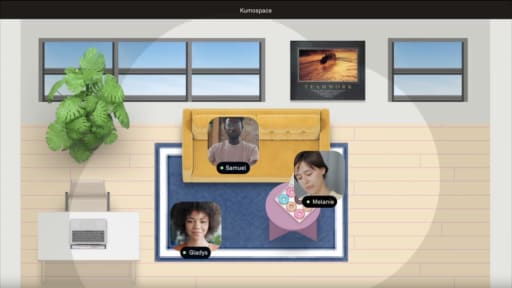
Kumospace is a spatial audio video chat platform shaped like a virtual office that stays open all day, with native video conferencing, team chat, screen sharing, spatial audio, an online whiteboard, and document sharing. It also supports larger virtual events, webinars, and all-hands meetings from the same persistent environment.
- Persistent rooms for teams and projects mean your workspace does not disappear when a meeting ends. You can allocate rooms or "neighborhoods" for departments, with presence indicators so people can walk up for quick questions without scheduling a call.
- Flexible layouts work for both internal collaboration (focus rooms, meeting rooms, social lounges) and external events (guest access for webinars, town halls, recruiting days), bringing events and everyday work into one platform.
- Named outcomes demonstrate demand for this model. Primerica used Kumospace to support a distributed organization, doubling revenue and saving $100,000 a year in rent. NASA hosted a virtual recruitment event with over 500 participants on Kumospace. These are specific examples of what the platform can support, not typical results.
- Native feature consolidation reduces tool sprawl. Because Kumospace provides virtual office, video conferencing, webinars, team chat, screen sharing, document sharing, recording, and analytics natively across desktop, iOS, and Android, teams can learn and use one interface instead of stitching together separate tools for events, meetings, and day-to-day remote work.
Kumospace usually is not the cheapest option if you only need occasional events and have no use for a virtual office between them. Whole-team adoption is required to get full value from the always-on presence model, and some teams need a week or two of regular use before the spatial interface feels completely natural.
Which Remo alternative is right for your team
Start with the case where the answer is "none of them." If you sell tickets to large public conferences, stay on Remo. It handles up to 10,000 attendees on Enterprise with native paid ticketing and instant payouts. Kumospace was not built for that, and most comparison pages won't tell you so.
The question that actually matters is how often you run events, and whether you need the space in between. Remo is event-first: you pay per event cycle, and the room sits empty the rest of the time. Five rules cover most teams.
Choose Kumospace if you run internal events and want a virtual office the rest of the time. All-hands, onboarding, recruiting days, career fairs. The people attending those are the same people who need somewhere to work on the other 360 days. That is the case Kumospace is built for, and it's why teams stop paying separately for an events tool and a meetings tool. Free up to 5 people, $16/user/month on Business.
Choose BigMarker if most of your events are registration-driven webinars. Marketing programs feeding an on-demand content hub need lead routing and automation more than table-based networking.
Choose Airmeet if you run recurring public community events. Speed networking, social lounges, and sponsor tables cover similar ground to Remo, with a community-first orientation.
Choose Zoom Events if your organization already runs on Zoom. You extend infrastructure you already own instead of adding a vendor. You give up immersive networking to do it.
Choose Cvent if you're running conferences with real logistics. Onsite check-in, exhibitor management, multilingual support. That's enterprise event management, and no virtual office replaces it.
Whatever you shortlist, run the same real event on two platforms before signing anything. Remo offers a 14-day free trial with no credit card, and most alternatives offer trials or free tiers.
What happens when you switch from Remo
Almost none of the work is data migration. Four things to plan for.
Export your recordings first. Remo stores presentation recordings for 30 days, so anything older is already gone. Attendee lists, registration data, and chat and Q&A transcripts export normally, but get the current export scope and retention terms from Remo in writing before you cancel, because they vary by plan and account status.
Time it against your renewal. Remo's Starter plan bills quarterly or annually from $299/month. There's no month-to-month exit, so check the notice period before signing elsewhere.
Give your hosts a dry run. Remo's Conversation Mode and Presentation Mode toggle doesn't exist anywhere else. Whoever runs your events needs practice before a live audience watches them learn it.
Run one real event as a go/no-go. A genuine event, real attendees, a month or two before the contract ends. That tells you more than any feature table, and it leaves room to renew if the answer is no.
One caveat about moving to an always-on office: the adoption curve is different. Event tools succeed one event at a time. A virtual office only pays off once standups and 1:1s actually move into it, which is a management decision more than a software one. The teams where it works are the ones where leadership moves first.
Summary
Is it worth switching from Remo? Only if your utilization says so. The best Remo alternative is decided by how often the room is occupied, not by which feature list runs longer. Remo starts at $299/month for 200 attendees and scales to 10,000 on Enterprise, billed quarterly or annually. For a team running large ticketed conferences, that is money well spent. For a team running four internal events a year, it is a venue rented by the year and used by the afternoon.
One practical note before shortlisting Remo alternatives: only Remo, Airmeet, and Kumospace publish rates. BigMarker and Cvent quote every tier privately, and Zoom publishes capacity but not price. Three of these Remo competitors require a sales call before you see a number, so budget evaluation time accordingly.
Whichever way you go, the number that matters after the switch is not attendee count. It's how many days a year anyone logs in.
Frequently Asked Questions
Yes. You can keep existing flagship events on Remo while piloting smaller gatherings or internal meetings on the new platform for a few weeks. This dual-running period lets you compare engagement and host workload directly, but set a clear cutoff date for deciding which tool will own which types of events so you avoid long-term duplication of cost and effort.
Adoption speed depends more on manager behavior and how quickly recurring events and meetings are moved to the new tool than on technical setup, since most platforms are straightforward to configure. Scheduling a few mandatory internal walk-throughs and making the new environment the default for specific meeting types usually matters more than optional "play around when you have time" invitations.
Attendee lists, registration details, and chat and Q&A transcripts generally remain exportable from Remo, subject to your account status. Recordings are the exception: Remo stores presentation recordings for 30 days, so pull anything you need before that window closes. Live engagement features like in-event chat threads and reactions typically archive as static exports rather than importing into another platform's interactive interface.
Remo's Starter plan bills quarterly or annually, so there's no month-to-month exit. Ask both Remo and any prospective alternative about short-term or pilot pricing to avoid two overlapping long commitments. See the switching section above for the full sequence.
The most accurate way to compare cost is to calculate annual spend for your expected number of hosts and events on each platform, then add any separate tools you would still need for a virtual office or webinars. If a Remo alternative like Kumospace also replaces other paid tools such as standalone video conferencing or virtual office software, subtract those savings to see the true net cost difference.