Low morale rarely announces itself. No alarm goes off when your team starts quietly disengaging. Instead, it shows up as slower response times, fewer ideas in brainstorms, a spike in "quick question" meetings that used to be handled in passing, and a general flatness that's hard to name but impossible to ignore. By the time most managers notice it, the damage has been compounding for weeks.
The conversation around workplace morale tends to default to surface-level fixes like pizza parties, gift cards, and forced fun on Friday afternoons. Those gestures aren't harmful, but they don't address the structural issues that actually erode how people feel about their work. Real morale boosters at work are rooted in how teams communicate, how recognition flows, how much autonomy people have over their days, and whether the environment they work in makes collaboration feel effortless or exhausting.
This guide explains how to boost employee morale, why most quick fixes fall short, and how to build systems that sustain motivation over months rather than manufacturing it for an afternoon.
Key Takeaways
- Workplace morale is driven by structural factors like autonomy, recognition, and communication quality, not perks or one-off events.
- The most effective morale boosters at work reduce friction in how people collaborate and make day-to-day interactions feel more human.
- Recognition needs to be specific, timely, and visible to the team rather than saved for quarterly reviews or annual awards.
- Autonomy over when, where, and how people do their work is one of the strongest predictors of sustained morale.
- For remote and hybrid teams, the virtual environment itself shapes morale, and platforms like Kumospace help recreate the casual connection that keeps people engaged.
Why Does Workplace Morale Matter?

Workplace morale is a leading indicator of retention, productivity, and the quality of work your team produces. Gallup's ongoing research into employee engagement consistently finds that teams with high engagement outperform their disengaged counterparts on profitability, customer ratings, and turnover. The relationship between how people feel at work and how they perform isn't debatable at this point. It's one of the most well-documented dynamics in organizational psychology.
For project managers, low morale shows up as missed deadlines and an unwillingness to flag risks early. For engineering teams, it surfaces as declining code quality, less rigorous reviews, and a reluctance to take on complex problems. For marketing teams, it means safe, uninspired work that checks boxes without moving the brand forward. Across every function, the pattern is the same: when people stop caring, the work suffers in ways that are hard to trace back to a single cause but obvious in aggregate.
The challenge is that morale isn't something you can mandate. You can't send a Slack message asking everyone to be more engaged. What you can do is build conditions where engagement happens naturally, and remove the friction that slowly grinds it down.
How to Build Morale at Work Through Everyday Practices

Workplace morale is a leading indicator of retention, productivity, and the quality of work your team produces. Gallup's ongoing research into employee engagement consistently finds that teams with high engagement outperform their disengaged counterparts on profitability, customer ratings, and turnover. The relationship between how people feel at work and how they perform isn't debatable at this point. It's one of the most well-documented dynamics in organizational psychology.
For project managers, low morale shows up as missed deadlines and an unwillingness to flag risks early. For engineering teams, it surfaces as declining code quality, less rigorous reviews, and a reluctance to take on complex problems. For marketing teams, it means safe, uninspired work that checks boxes without moving the brand forward. Across every function, the pattern is the same: when people stop caring, the work suffers in ways that are hard to trace back to a single cause but obvious in aggregate.
The challenge is that morale isn't something you can mandate. You can't send a Slack message asking everyone to be more engaged. What you can do is build conditions where engagement happens naturally, and remove the friction that slowly grinds it down.
How to Build Morale at Work Through Everyday Practices
The most effective approach to building morale at work is a set of small, consistent practices woven into the daily rhythm of your team. These aren't expensive, and they don't require executive approval. They just require intentionality.
Make Recognition Specific and Frequent
Generic praise doesn't land. Telling someone "great job" in a team meeting is forgettable. Telling them "the way you restructured that API response cut our load time by 40%, and the client noticed" is something they'll remember for months. Specific recognition reinforces the behaviors you want to see repeated and signals to the rest of the team what good work actually looks like.
Recognition also needs to flow in every direction, not just top-down. Peer-to-peer recognition often carries more weight because it comes from people who understand the difficulty of the work firsthand. Create lightweight channels for this, whether that's a dedicated Slack channel, a standing agenda item in retros, or a shared space in your virtual office where shout-outs are visible to the whole team.
Protect Autonomy Over the Workday
Few things erode morale faster than micromanagement, and few things build it faster than trust. When people have control over how they structure their day, which hours they work, and how they approach their tasks, they invest more of themselves in the outcome. Research from the self-determination theory framework consistently shows that autonomy is one of the three core psychological needs that drive intrinsic motivation, alongside competence and relatedness.
In practice, this means setting clear expectations for outcomes and deadlines while giving people freedom in how they get there. It means resisting the urge to require cameras-on for every meeting. And it means evaluating people on what they deliver rather than when they log on.
Lower the Barrier to Casual Interaction
One of the biggest morale killers in remote and hybrid teams is isolation. When every interaction requires a calendar invite, people stop reaching out for the small conversations that build trust and camaraderie. The hallway chat, the two-minute check-in after a tough meeting, the spontaneous "hey, want to grab coffee and talk through this idea" moments all disappear when your team's only shared space is a grid of video tiles.
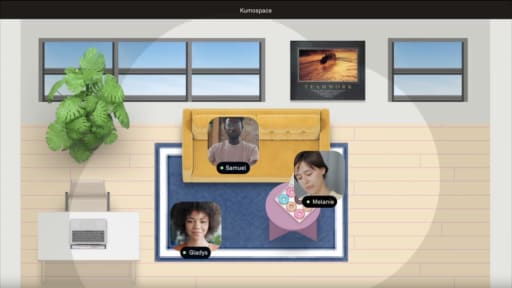
This is where your work environment makes a measurable difference. Virtual office platforms like Kumospace recreate the spatial dynamics of a physical office, letting people see who's around, drop into casual conversations, and collaborate without the overhead of scheduling. When interaction is effortless rather than effortful, people connect more frequently, and that connection is the foundation of sustained morale.
Give People Meaningful Work and Context
People want to know that what they're doing matters. That sounds obvious, but it's remarkable how many teams operate without a clear line of sight between individual tasks and company outcomes. An engineer fixing a bug needs to know that the fix unblocks a feature that drives revenue. A content marketer writing a blog needs to understand how it fits into the broader acquisition strategy.
Context isn't a one-time onboarding exercise. It's something leaders need to reinforce continuously through team meetings, project kickoffs, and one-on-ones. When people understand the "why" behind their work, they bring more energy and creativity to the "how."
Create Space for Growth
Stagnation is a morale killer that creeps in slowly. When people feel like they've stopped learning or that there's no clear path forward, they start looking elsewhere, mentally if not literally. How to improve staff morale in this dimension doesn't require a formal training budget, though that helps. It can be as simple as giving people stretch assignments, pairing junior team members with senior ones on complex projects, or carving out time each week for learning and experimentation.
Engineering teams benefit from dedicated hack time or internal tech talks. Marketing teams benefit from cross-functional exposure to product and sales. Project managers benefit from mentorship circles where they can share challenges and strategies with peers. The specific format matters less than the signal it sends: we invest in your development because we want you here long-term.
How to Improve Staff Morale When It's Already Low

Building morale from a healthy baseline is one thing. Recovering it after a rough quarter, a round of layoffs, or a period of sustained overwork is a different challenge entirely. Leaders looking to boost employee morale often feel pressure to make big gestures, but what employees usually need most during recovery is honesty, stability, and clear evidence that conditions are improving.
Start by acknowledging what happened. Teams can sense when leadership is pretending everything is fine, and that pretending accelerates distrust. A straightforward conversation about what went wrong and what the team is doing differently going forward does more for morale than any offsite or bonus ever could.
Then focus on reducing load before adding anything new. When morale is low, people are already running on empty. Piling on team-building activities or new initiatives feels tone-deaf. Instead, look for work that can be deprioritized, meetings that can be cut, and processes that can be simplified. Giving people breathing room is one of the most powerful morale boosters at work, even though it doesn't feel like a "program."
Rebuild trust through consistency. Follow through on the changes you promised. Show up to one-on-ones. Remove the blockers your team told you about. Morale recovers when people see sustained evidence that their environment is improving, not when they hear a single inspiring speech.
Boosting Employee Morale Across Remote and Hybrid Teams
The shift to distributed work created a new set of morale challenges that most playbooks haven't caught up with. Boosting employee morale in remote environments requires deliberate attention to the things that used to happen organically in an office.
Informal communication needs to be designed, not left to chance. This could mean virtual coffee chats, open-door hours where leadership is available for casual conversation, or simply choosing a work environment that makes spontaneous interaction possible. Teams using Kumospace often find that morale improves simply because people stop feeling like they're working alone. The ability to see your teammates, overhear a conversation, or pop into a room for a quick laugh restores the ambient social texture that Slack channels and Zoom calls can't replicate.
Visibility into each other's work also matters. When remote team members can't see what their colleagues are building or how their own contributions fit into the larger picture, disconnection sets in. Shared dashboards, regular demo sessions, and collaborative workspaces where progress is visible all help maintain the sense of collective momentum that fuels morale.
Finally, be intentional about celebrating wins. Remote teams miss out on the natural celebration that happens when everyone is in the same room. A project ships, and the Slack thread gets a few emoji reactions, but it doesn't carry the same energy as the team hearing applause from across the office. Find ways to make wins feel real, whether that's a dedicated celebration channel, a monthly team highlight reel, or a live virtual gathering where people can actually see each other's reactions.
The Long Game
Morale is a condition you maintain through hundreds of small decisions about how your team works together, how people are recognized, how much trust they're given, and how connected they feel to each other and to the mission. The most effective morale boosters at work aren't programs or perks. They're structural choices about communication, autonomy, and environment that compound over time.
Whether your team sits in the same office or is spread across five time zones, the principles are the same. Remove unnecessary friction from collaboration. Recognize good work when it happens. Give people control over their days. And invest in an environment, physical or virtual, where people actually enjoy showing up.
The teams that get this right don't just have happier employees. They ship better work, retain their best people, and build the kind of culture that attracts talent without needing to sell it.
How Kumospace Helps Boost Employee Morale

For remote and hybrid teams, the work environment itself has a major impact on morale. When every interaction requires a scheduled meeting or long Slack thread, collaboration starts to feel transactional and isolating instead of natural and energizing.
This is where Kumospace helps teams stay connected. Kumospace creates a shared virtual workspace where employees can see who is available, join quick conversations, collaborate in real time, and recreate the casual interactions that are often missing in distributed work environments.
Features like spatial audio, breakout rooms, virtual lounges, games, and customizable office spaces make collaboration feel more human and less rigid. Teams can celebrate wins, host informal conversations, brainstorm ideas, or quickly solve blockers without needing to schedule another formal meeting.
Kumospace also improves visibility and team connection across departments, helping employees feel more engaged in the work happening around them. That sense of everyday interaction and shared presence plays a major role in maintaining morale, strengthening collaboration, and reducing the isolation that often contributes to disengagement in remote work environments.
Summary
Morale is shaped by everyday conditions: whether communication is clear, whether good work gets noticed, whether people have enough autonomy to do their jobs without constant check-ins. Teams with high morale collaborate better, retain talent longer, and bounce back from setbacks faster. Low morale tends to show up quietly, through disengagement, slower output, and burnout that builds before anyone names it.
The most effective fixes focus on reducing friction. Specific and timely recognition, trust over micromanagement, room to grow, and space for casual interaction all matter more than most leaders expect. For remote and hybrid teams, the environment itself is part of the equation. Tools like Kumospace help recreate the spontaneous hallway conversations and ambient visibility that offices provide naturally, making distributed work feel less isolating. Organizations that get communication, autonomy, and connection right build stronger cultures and healthier teams.
Frequently Asked Questions
The most effective morale boosters at work are specific and frequent recognition, autonomy over the workday, reduced friction in collaboration, and meaningful connections between individual tasks and company outcomes. Surface-level perks like pizza parties provide temporary lifts, but sustained morale comes from structural changes to how teams communicate and how people experience their daily work.
Building morale for remote teams requires designing informal communication into the workday rather than leaving it to chance. Virtual office platforms like Kumospace recreate the casual interactions that build trust and reduce isolation, while regular demo sessions and shared dashboards maintain the sense of collective momentum that remote workers often lose.
Low workplace morale is most commonly caused by micromanagement, lack of recognition, isolation from teammates, unclear purpose behind the work, and stagnation in professional growth. These factors compound gradually, which is why morale problems often go unnoticed until they're already affecting retention and output quality.
Managers should start by honestly acknowledging what went wrong rather than pretending everything is fine, then reduce workload before introducing new initiatives. Morale recovers through sustained, consistent follow-through on promised changes rather than one-time gestures or grand speeches.
The work environment directly shapes how often and how easily people interact, which is one of the strongest drivers of engagement and belonging. Teams that work in shared spaces where casual conversation and spontaneous collaboration happen naturally report higher morale than teams that rely solely on scheduled meetings and async messaging tools.