Finding the right person in your organization used to mean shouting across the office or flipping through a binder. In 2026, that approach doesn’t scale. An employee contacts system is a centralized digital list of names, roles, and ways to reach everyone in the company including email, phone, Slack, and Kumospace. For distributed engineering teams building AI products across time zones, reliable contact information is essential infrastructure that makes collaboration possible.
What Are Employee Contacts?

An employee contacts system at its core is a searchable record of how to reach every person in your company. Unlike the Excel lists that circulated via email in the 2010s, modern employee contacts live inside HR software, collaboration tools, and virtual office platforms like Kumospace. They update automatically, sync across other systems, and provide quick access to the people you need.
The shift to hybrid and remote work makes this crucial. When your ML engineer is in Berlin, your product manager is in San Francisco, and your data scientist just joined from Singapore, you cannot rely on bumping into people in the hallway. Employee contacts become the connective tissue that holds distributed teams together, especially in engineering-heavy organizations where the right technical expertise might sit three time zones away.
For AI startups scaling fast, the stakes are higher. A company that hires five engineers through structured hiring in Q2 2026 needs those new employees visible and reachable from their start date. When contact details are wrong or missing, onboarding slows down, Slack channels go quiet, and new hires spend their first week asking “who owns this?” instead of shipping code.
The connection between hiring velocity and contact accuracy is direct. High-growth tech companies using structured hiring processes, where candidate data like preferred name, location, and communication preferences are captured early, can flow that employee information straight into their directory. This saves time, reduces errors, and ensures that by a new hire’s first morning, colleagues can find and message them properly.
Why this matters for your business: companies with strong employee engagement do not just have happy workers; they have workers who can actually find each other. When a production incident hits at 2 AM, the on-call engineer needs to locate the right people in seconds, not minutes. That is the difference between a 10-minute resolution and a customer-facing outage.
Employee Contacts vs. Employee Directory vs. Employee List
These three terms are often used interchangeably, but they describe different things. Employee contacts refer to the practical ways to reach people: email addresses, phone numbers, Slack handles, and Kumospace room links. It is the “how do I get in touch” layer. An employee directory is richer and includes profiles with org structure, job title, department, manager relationships, and often photos. It answers “who is this person and where do they sit in the company.” An employee list is typically the simplest version: a basic spreadsheet with names and maybe an address or two.
In practice, companies blend all three concepts into a single searchable system. HR tools use terms like “people directory,” “org chart,” or simply “contacts.” What matters is whether your team can find the person they need in under 30 seconds. If your current setup requires opening three different tools and cross-referencing a spreadsheet, you are working with yesterday’s infrastructure.
What Information to Include in an Employee Contacts System
The right data balance is “enough to work fast, not enough to create privacy risk.” Include too little and people cannot find who they need. Include too much and you expose sensitive data or violate data protection laws. Core fields to include in every employee profile are full name, preferred name, current role, team or department, direct manager, work email, work phone or extension, instant messaging handle, office or remote status, location and time zone, Kumospace room or floor link, and key skills relevant to your business.
Optional but high-value fields add context without crossing into private information, including languages spoken, typical working hours, pronouns, a brief “how to work with me” note, hire date or work anniversaries, current project or squad name, and emergency contacts with restricted visibility to HR and managers only. Fields that should be restricted to HR only and never appear in the open directory include home address, personal phone numbers, compensation details, government IDs, bank account information, and any health or benefits data. This separation protects sensitive information while still making day-to-day collaboration seamless.
For global teams, localize contact formats. Include country codes for phone numbers, display time zones prominently, and consider adding local public holidays to profiles. A US-EU-APAC engineering team needs to know at a glance whether their colleague in Berlin is awake before sending a Slack message expecting an immediate reply.
Core Benefits of a Strong Employee Contacts System

Accurate employee contacts improve speed, collaboration, and compliance, especially in remote-first organizations where you cannot just walk to someone’s desk. A well-maintained system delivers faster communication and reduced search time. A product manager who needs to find the right ML engineer to discuss a model performance issue can search by skill and location and find the right person in under 30 seconds instead of waiting for replies in a general channel.
It also provides cross-team visibility that prevents misrouted requests. When engineering, sales, and customer success can see who owns which systems, accounts, or domains, requests go to the right people the first time. Better remote and hybrid coordination comes from seeing time zones, preferred channels, and Kumospace availability, preventing late-night pings and missed handoffs.
A strong employee contacts system also smooths onboarding for new hires. New engineers can click through an org-wide contact map on day one instead of spending weeks asking who to talk to. They see their team, their skip-level, the people they will work with on their first project, and how to reach each one. Up-to-date manager mappings and emergency contacts matter for compliance and safety in urgent situations. Knowing exactly who to contact and how can be the difference between a managed situation and chaos.
Basic vs. Advanced Employee Contacts Systems
The gap between a 2018 Excel contact list and a 2026 integrated system is enormous. Understanding where your organization sits on this spectrum helps you plan upgrades that actually improve collaboration.
A basic system is usually a manual spreadsheet or static PDF containing names, emails, and sometimes phone numbers. Someone in HR or operations updates it quarterly if they remember. When people join or leave, there is often a lag of days or weeks before the list reflects reality. Duplicates appear, departed employees linger, and new employees are invisible until someone manually adds them. For a 10-person seed-stage startup, this may be sufficient. For a fast-growing company, it becomes a liability.
An advanced system automatically syncs with your HRIS, applicant tracking system, and collaboration tools. It supports search by skills, projects, departments, and availability. It works on mobile and desktop and connects to Slack, email, calendar, and Kumospace so employee data is consistent everywhere. When someone’s role changes in the HR system, their contact record updates within hours instead of weeks.
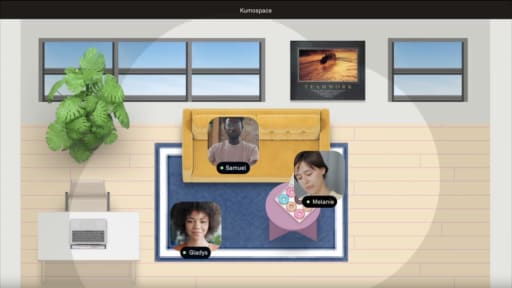
Virtual office integration adds real-time presence. Tools like Kumospace show who is online, which room they are in, and whether they are in a meeting or available. This turns a static contacts list into a live map of your company, so instead of wondering if a colleague is free, you can see their current location and availability.
Best Practices for Maintaining Accurate Employee Contacts
The main failure point is not software; it is keeping data current as people change roles, teams, and locations. A perfectly designed system with stale records is worse than useless; it actively misleads.
Give HR a clear process tied to trigger events. Contacts should update at specific moments such as offer acceptance, start date, promotion, internal transfer, team change, manager change, and offboarding. Build these into your HRIS workflows so updates happen automatically instead of relying on someone remembering to edit a spreadsheet.
Enable self-service updates for appropriate fields. Let employees edit their preferred name, profile photo, pronouns, working hours, Kumospace room link, and “how to reach me” preferences. They know this information best. Restricting updates to HR for every field creates bottlenecks and guarantees outdated records.
Schedule regular audits for larger organizations. Companies over 100 people should run monthly or quarterly reviews to verify managers, teams, and locations against HR system records. Cross-reference your employee directory with actual org charts. Flag profiles that have not been updated in six months. Use these audits to catch people who changed teams but never told anyone.
Integrate your tools to create a single source of truth. Sync data from your HR system, Slack or Teams, calendar, Kumospace, and identity management tools. When these systems disagree, people lose trust in the data. Aim for one authoritative source, usually the HRIS, that pushes updates everywhere else.
A practical timeline for new hires:
- Week -1 (before start): HR creates the contact record from offer data assigns manager and team
- Day 1: Employee appears in directory with core fields populated, receives login to self-update optional fields
- Week 1: Employee completes their profile with photo, working hours, skills, “how to work with me” note
- Day 30: Manager confirms team and project assignments are correct in the system
Security, Privacy, and Compliance for Employee Contacts

Employee contact systems touch personal data and must respect privacy regulations such as GDPR, CCPA, CPRA, and LGPD. Role-based access is foundational. Regular employees see contact info, roles, teams, and skills. HR sees extended fields like home address, emergency contacts, and hire date. Executives might access headcount reports by department. Sensitive data such as salary, government IDs, and benefits should never appear in the general directory.
Technical controls protect against breaches. Require SSO and MFA for access. Implement field-level permissions. Use IP restrictions for sensitive fields. Encrypt employee data at rest and in transit. Internal policies prevent informal data leakage. Define clearly what must not be copied, emailed externally, or shared outside secure tools. Audit logs track who changes what and when. Every edit should record who made the change, when, and from what value to what value.
A privacy-safe profile example: visible to all employees: name, preferred name, role, team, manager, work email, Slack handle, Kumospace room, skills, time zone; visible to HR only: home address, personal phone, emergency contacts, hire date, salary band, performance records; visible to no one: government IDs, bank details, health information. For executives and security personnel, consider limiting even basic presence data if roles create safety concerns.
How Different Teams Use Employee Contacts Day to Day
Different teams use contacts differently. Engineering relies on skills and stack-based search for troubleshooting, code review, or incident response. HR coordinates onboarding, verifies managers for new hires, triggers recognition programs, and produces workforce reports. Sales, customer success, and support teams find technical experts quickly to respond to prospects or tickets. Remote collaboration ties all of this together. A product manager can see an engineer in the “ML Team Lounge” room with status “available,” join the room, and get answers without Slack threads or calendar invites.
Adding contact rules to profiles helps manage expectations. Notes such as “Message me on Slack first. Call only for P0 incidents. I do not check email during deep work blocks 9 AM–12 PM PT” reduce friction and respect preferences. These entries make the contact system a tool for both information and real-time connection.
Implementing an Employee Contacts System: Step-by-Step
This is a practical, chronological plan suitable for startups scaling from 10 to 250 people in 12 to 18 months. The goal is to build a system that is useful today and extensible as you grow.
Step 1: Define scope. Decide which fields will be visible to everyone, which are HR-only, and which are opt-in. Draft a simple data policy. For example, everyone sees name, role, team, email, Slack, skills, and Kumospace location; HR sees hire date, manager history, and emergency contacts; employees can optionally add pronouns, languages, and “how to work with me” notes. Write this down before you touch any software.
Step 2: Choose a platform. Evaluate HRIS tools like Rippling, BambooHR, or Gusto, collaboration platforms with built-in directories such as Slack Enterprise Grid or Microsoft Teams, and virtual office tools like Kumospace that combine presence with profiles. Decide whether to use a dedicated directory tool or build on functionality inside existing systems. For most scaling startups, the HRIS should be the source of truth with syncs to other tools.
Step 3: Clean and migrate data. Pull data from existing spreadsheets, email address books, Slack profiles, and ATS exports. Fix duplicates. Remove departed employees. Correct outdated roles and team assignments. This cleanup is tedious but essential. Assign one person to own this migration rather than spreading it across the team.
Step 4: Configure search and structure. Set up departments such as Engineering, Product, GTM, and Operations. Define squads or teams within departments. Create skill tags that match how people actually describe their work: “LLM Infra,” “Data Platform,” “Frontend,” “Security,” “DevOps.” Test the search function yourself. Can you find a backend engineer in the Berlin office who knows Rust in under 15 seconds?
Step 5: Roll out and train. Pick a launch date. Send an internal announcement explaining what the new directory is, why it matters, and how to use it. Record a short Loom demo. Add directory orientation to your new hire onboarding checklist. Remind people to complete their profiles with skills, photo, and working hours.
Step 6: Review and iterate. Schedule a 90-day post-launch review. Gather feedback. What fields are missing? What is hard to find? Is search fast enough? Add requested fields, improve tagging, and tighten integrations. A contacts system is never done. It is a living tool that evolves with your organization.
Employee Contacts in a Hybrid and Virtual Office World

In 2026, many AI and software companies operate “virtual-first,” combining physical hubs in cities like San Francisco, New York, and London with tools like Kumospace to simulate the ambient awareness of an office. Employee contacts are the foundation that makes this work.
Contact profiles feed virtual office environments. Each employee’s profile links to a virtual desk, floor, or room. When someone searches for a colleague, they don’t just see email and phone. They see where that person is in the virtual office right now. They can click and “walk over” digitally, starting a conversation without scheduling a meeting.
Real-time presence transforms contacts from static data to live status. A profile that shows someone is in a Kumospace meeting room, in “deep work” mode, or at lunch changes how you approach them. You wouldn’t interrupt a colleague in a physical meeting room. The same awareness should exist virtually. This improves the timing of outreach and reduces frustrating interruptions.
A concrete example: a three-continent team with engineers in New York, Berlin, and Bangalore. The contact directory shows each person’s local time, core working hours, and virtual office location. During a production incident, the on-call engineer in New York checks the directory, sees that the database expert in Bangalore is online and in the “Infra War Room,” and joins immediately. The emergency contact flow works because the data is correct and the presence is visible.
Suggested additional fields for hybrid environments include “core collaboration hours” (when someone is available for synchronous meetings), “virtual office hours” (when they’re typically in Kumospace), and preferred async vs. sync communication style. These fields, embedded in the contacts system, set expectations and reduce the friction of working across locations.
The Future of Employee Contacts: AI, Skills Graphs, and Dynamic Profiles
Looking ahead to 2026 to 2030, employee contacts are evolving from static records to dynamic, intelligent systems that actively help people connect.
AI-driven recommendations are emerging. Instead of searching for a colleague, you describe what you need: “I need someone who can review my CUDA kernel optimization.” The system suggests the three best people based on skills data, current workload, availability, and past collaboration patterns. This is already happening in early forms in 2026, and it’s accelerating.
Dynamic profiles update themselves based on actual work. Skills and project fields refresh automatically from Git commits, Jira tickets, and project boards. An engineer who spends three months building a recommendation system sees “RecSys” added to their profile without lifting a finger. This creates a real-time “skills graph” of the company, a living map of who knows what.
Privacy and ethics remain central. Employees should opt in to AI-enhanced features. Recommendations should be explainable, for example “we suggested Alex because they have Kubernetes experience and are available,” not opaque. There should also be a clear separation between basic contact visibility and performance evaluation. Your directory shouldn’t feel like surveillance.
The foundation is what you build today: clean data, clear policies, integrated tools, and a culture that values keeping information up to date. Start there, and future capabilities will have something solid to build on.
Conclusion
Employee contacts are no longer just a static directory. They are becoming a core layer of how modern teams communicate, collaborate, and respond in real time. As companies continue shifting toward hybrid and virtual-first work, accurate contact data, visible presence, and skill-based context make it easier to find the right person, reach them at the right moment, and work more effectively across locations. The organizations that treat their contact systems as living infrastructure, not an afterthought, will be better positioned to support fast-moving teams today and adopt more intelligent, connected workflows in the years ahead.
Frequently Asked Questions
An effective employee directory should include role, team, manager, location, time zone, areas of expertise, profile photo, and preferred communication methods so employees can quickly find and reach the right person.
Automated search helps employees instantly find colleagues, roles, or expertise without asking around or checking outdated documents, reducing interruptions and speeding up decisions.
Sync the directory with HRIS and identity systems, automate updates tied to role changes, allow limited self-editing, and run regular audits to prevent outdated or duplicate records.
A searchable directory helps new hires quickly understand team structure, identify key contacts, and know who to reach out to for specific questions.
Use role-based access controls, encryption, and secure authentication, while limiting internal visibility and clearly defining how employee data is collected, stored, and used.